What to Expect, What to Ask, and How to Prepare
Receiving your first prosthesis can feel like one of the biggest milestones after limb loss. For many people, it represents independence, mobility, and the possibility of returning to activities that have become more difficult. It can also bring uncertainty, frustration, and expectations that do not always match reality.
One of the most important things to understand is that receiving a prosthesis is not the end of rehabilitation. In many ways, it is the beginning of another stage.
Learning to use a prosthesis takes time. Your residual limb will change. Your socket may need adjustments. Components may need to be changed. Some days will be easier than others. You may discover that a prosthesis works extremely well for certain activities but that you prefer another mobility option for others.
There is no single definition of successful prosthetic use.
Understanding how your first prosthesis is selected, fitted, adjusted, and incorporated into your daily life can make the process considerably less intimidating.
A Prosthesis Is a Tool, Not a Replacement Limb
One of the first adjustments is understanding what a prosthesis can—and cannot—do.
Modern prosthetic technology has advanced significantly. Depending on the level of limb loss, a prosthesis may help someone walk, stand, work, drive, exercise, cook, dress, participate in sports, or perform many other everyday activities.
But a prosthesis does not completely replace the limb that was lost.
It does not restore sensation. It requires additional energy to use. It places different demands on muscles and joints. It must be put on and removed. It requires maintenance, adjustments, and sometimes repairs.
For some people, a prosthesis becomes their primary means of mobility or function. Others use one only for certain activities. Someone with lower-limb loss may walk with prosthetic legs at home but use a wheelchair for longer distances. Someone with upper-limb loss may use a prosthesis for particular tasks but find that they can perform others more efficiently without it.
These choices are not failures.
The objective is not simply to wear a prosthesis for as many hours as possible. The objective is to find the combination of tools and strategies that gives you the greatest independence, comfort, safety, and quality of life.
Before You Receive Your First Prosthesis
Not everyone receives a prosthesis immediately after amputation.
Before fitting can begin, the residual limb generally needs sufficient healing and stability. Your healthcare and rehabilitation team will consider several factors, including:
- Healing of the surgical site
- Swelling and changes in residual-limb volume
- Skin condition
- Strength and range of motion
- Balance
- Overall health
- Pain levels
- Your ability to transfer or move safely
- Your personal mobility and functional goals
The timeline can vary considerably.
Some people progress relatively quickly. Others experience wound-healing problems, infections, additional surgeries, swelling, pain, or medical complications that delay prosthetic fitting.
Waiting can be particularly frustrating when you are eager to regain independence. However, allowing your body sufficient time to heal can make later prosthetic fitting safer and more successful.
Choosing the Right Prosthetist Matters
Your prosthetist is likely to become one of the most important members of your rehabilitation team.
A prosthetist is a healthcare professional who designs, fits, adjusts, and maintains prosthetic limbs. The relationship may continue for many years because prosthetic needs change over time.
Technical expertise matters, but communication is equally important.
You should feel comfortable explaining what hurts, what feels unstable, what activities are difficult, and what you hope to accomplish.
A good prosthetist should also be willing to explain why particular components are being recommended rather than simply telling you what you are receiving.
When choosing a prosthetist, consider asking:
- How much experience do you have with my level of limb loss?
- What prosthetic systems do you commonly work with?
- How frequently will I be seen during the initial fitting process?
- What happens if my socket becomes uncomfortable?
- How quickly can adjustments usually be made?
- What happens if a component breaks?
- What options are available within my funding or insurance coverage?
- How will you work with my physiotherapist or occupational therapist?
- What alternatives are available if the first design does not work well for me?
You are not being difficult by asking questions. You are participating in decisions about equipment that may affect you every day.
Understanding the Parts of Your Prosthesis
A prosthesis is usually made up of several components working together. The exact design depends on whether the prosthesis is for an upper or lower limb, the level of limb loss, your functional goals, and the technology being used.
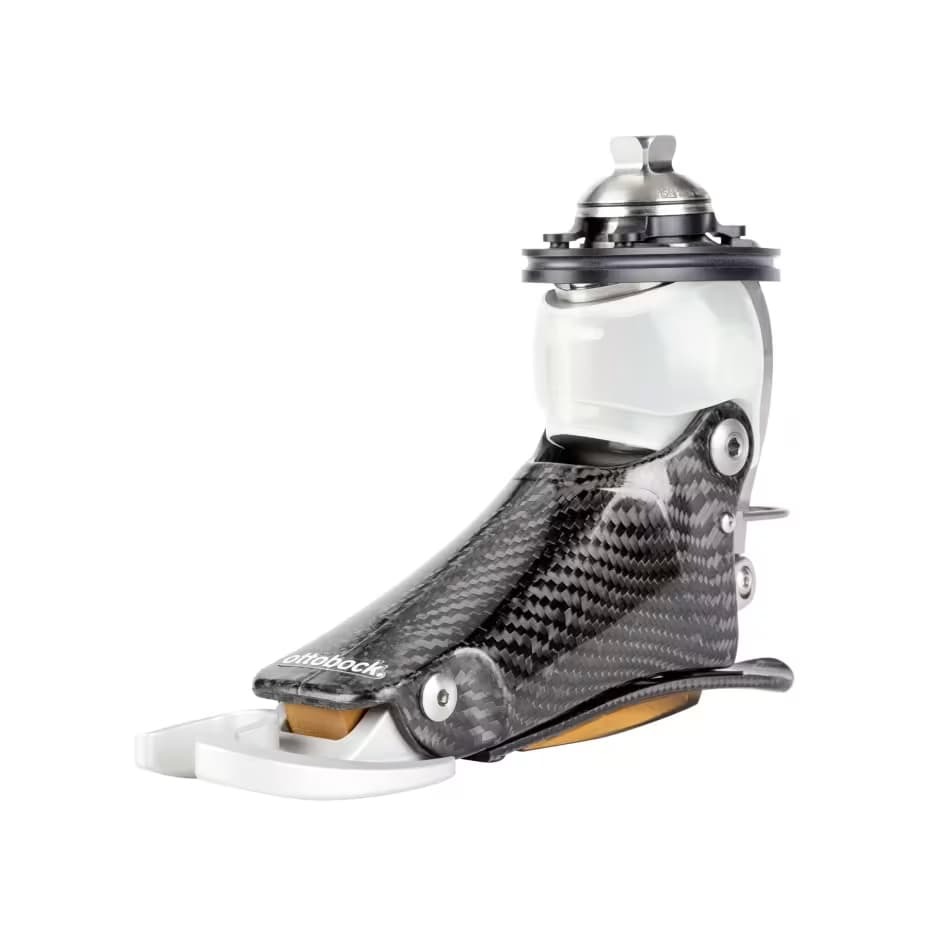
For a lower-limb prosthesis, common components can include the socket, suspension system, liner, adapters, pylons, prosthetic foot and, for people with above-knee limb loss, a prosthetic knee.
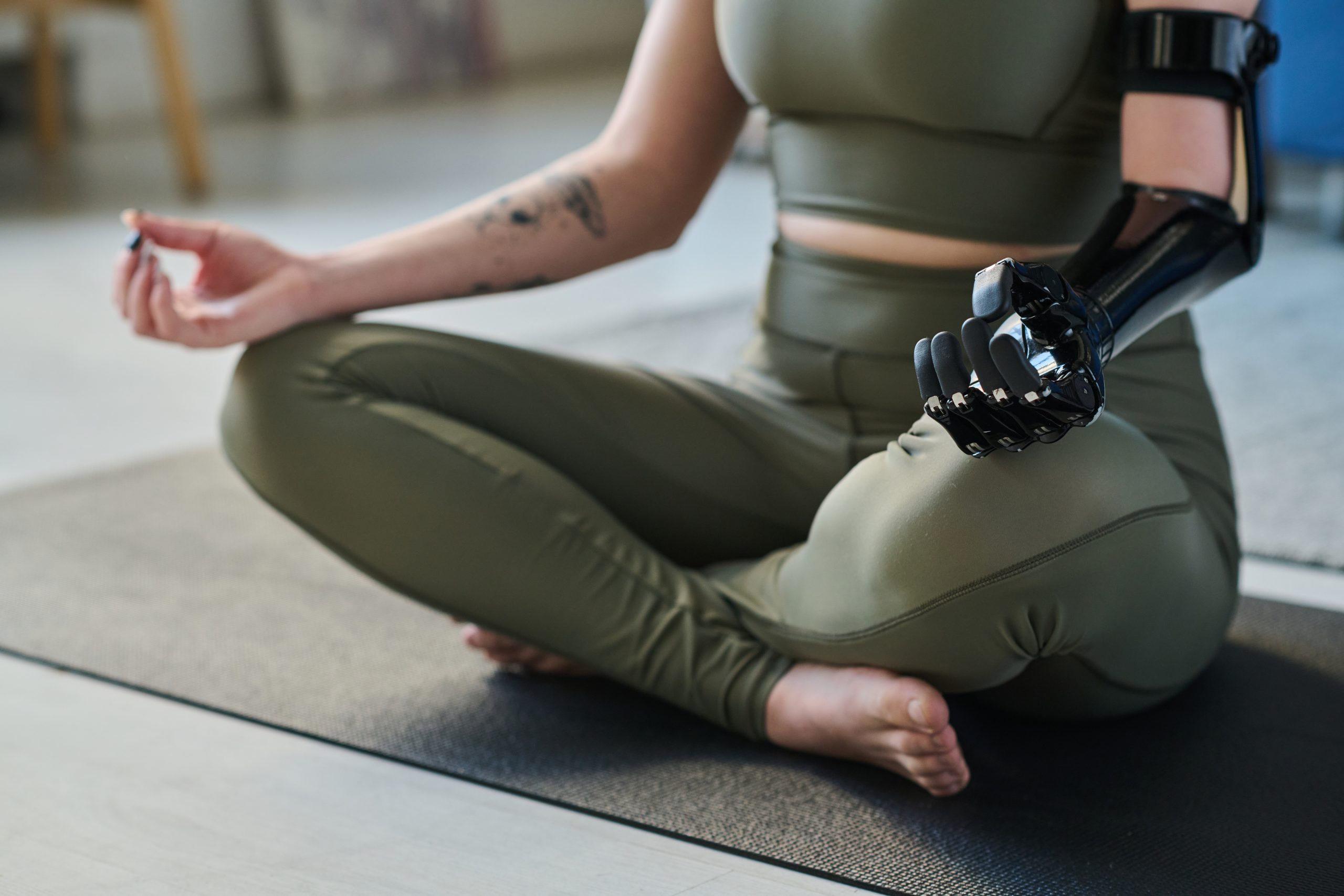
Upper-limb prostheses may include a socket, suspension system, joints, terminal devices such as hands or hooks, and mechanical or electronic control systems.
You do not need to become an expert immediately. However, understanding the basic components helps you participate in discussions about your care.
The Socket
For many prosthesis users, the socket is the most important part of the entire system.
The socket is the portion of the prosthesis that surrounds and connects to your residual limb.
Even the most advanced prosthetic foot, knee, hand, or electronic component cannot compensate for a poorly fitting socket.
A good socket needs to distribute pressure appropriately, provide stability, maintain suspension, and allow you to use the prosthesis without repeatedly damaging your skin. This is why prosthetists spend so much time evaluating and modifying socket fit.
Your Residual Limb Will Continue to Change
One surprise for many first-time prosthesis users is how much the residual limb can change after amputation.
Swelling generally decreases over time, muscles may change, body weight may fluctuate, and activity levels can affect limb volume.
This means a socket that fits well today may not fit exactly the same way several weeks or months from now.
For lower-limb prosthesis users, changes in fit may sometimes be managed temporarily by adjusting prosthetic socks or other aspects of the suspension system. At other times, the socket itself may require modification or replacement.
Do not assume that discomfort is something you simply have to tolerate. Persistent changes in fit should be discussed with your prosthetist.
Some Pressure Is Normal—Pain Is Different
Learning the difference between pressure and pain is an important part of becoming an experienced prosthesis user.
A socket has to make contact with your residual limb. You may feel pressure in areas that have not previously experienced it. However, significant pain should not simply be accepted as part of wearing a prosthesis.
Contact your prosthetist or healthcare team if you develop:
- Persistent redness
- Blisters
- Open wounds
- Skin breakdown
- Bleeding
- Significant swelling
- Sharp or severe pain
- Burning sensations
- Increasing residual-limb pain
- New areas of unusual pressure
Skin problems deserve particular attention for people who have reduced sensation, neuropathy, diabetes, circulation problems, or a history of difficult wound healing.
If you cannot reliably feel areas of excessive pressure, visual skin inspection becomes even more important.
Check Your Skin Regularly
During the early stages of prosthetic use, develop the habit of examining your residual limb every time you remove your prosthesis. A mirror can help you see areas that are difficult to inspect.
Look for changes in:
- Skin colour
- Redness
- Swelling
- Blisters
- Cuts
- Abrasions
- Pressure marks
- Drainage
- Unusual warmth
Some temporary redness after removing a prosthesis can occur. What matters is whether it resolves and whether the same area repeatedly becomes irritated.
Repeated skin damage is a warning that something may need to change. Never assume that you should simply “toughen up” your residual limb.
Learning to Use a Prosthesis Requires Rehabilitation
Receiving a prosthesis and knowing how to use one are very different things.
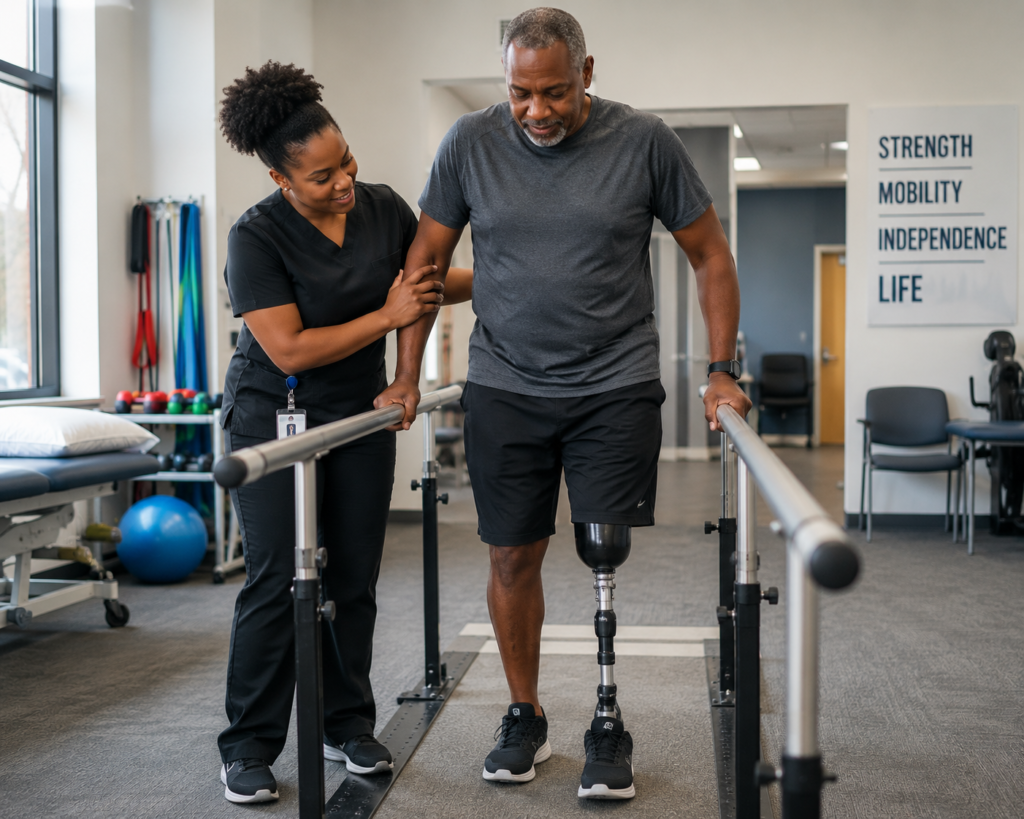
For lower-limb prosthesis users, physiotherapy may involve learning:
- Standing balance
- Weight shifting
- Walking between parallel bars
- Using a walker or other mobility aid
- Turning safely
- Walking on different surfaces
- Navigating ramps
- Climbing stairs
- Recovering from a loss of balance
- Falling safely and getting back up
- Building strength and endurance
For upper-limb prosthesis users, occupational therapy may focus on positioning, controlling the prosthesis, grasping objects, manipulating items, dressing, cooking, working, and performing other everyday tasks.
The goal is not merely learning how the prosthesis operates. The goal is learning how to incorporate it into your life.
Expect the First Few Weeks to Be Tiring
Prosthetic use requires physical and mental effort.
Walking with a lower-limb prosthesis generally requires more energy than walking with two biological limbs, and energy demands can increase as the level of amputation becomes higher.
During the early stages, you are also concentrating on things that were once automatic: Where is my foot? Is my knee stable? Is the socket slipping? Am I putting enough weight through the prosthesis? Is the ground level? Am I walking correctly?
That constant concentration can be exhausting.
With practice, many movements become more automatic. Strength and endurance may also improve. The important thing is to build gradually rather than assuming that exhaustion means you are doing something wrong.
Your First Prosthesis Probably Won’t Be Your Last
Your first prosthesis is often part of a continuing process.
Your residual limb may shrink considerably during the first year. Your activity level may increase. Your goals may change. You may discover that certain components work better for you than others.
Eventually, you may require a new socket or different components.
Over the years, prosthetic needs can continue changing because of:
- Weight changes
- Changes in strength
- Aging
- Changes in health
- New activities
- Changes in work
- Advances in prosthetic technology
- Wear and tear on components
Think of prosthetic care as an ongoing relationship rather than a one-time purchase.
Understanding Prosthetic Feet, Knees, Hands and Other Components
It can be tempting to assume that the newest or most technologically advanced component must automatically be the best. That is not always the case.
Different components are designed for different functional needs.
For example, prosthetic feet can vary considerably in their flexibility, energy return, stability, weight, waterproof capabilities, and suitability for different activity levels. Prosthetic knees range from relatively simple mechanical systems to sophisticated microprocessor-controlled knees.
Upper-limb systems may include passive devices, body-powered prostheses, myoelectric systems, task-specific devices, and other technologies.
The most expensive component is not necessarily the most appropriate one.
The better question is: What component best supports the activities that matter to me?
That is why your prosthetist needs to understand your actual life—not just your amputation level.
Tell Your Prosthetist What You Want Your Life to Look Like
Do not limit the conversation to basic mobility. Tell your prosthetist about your goals.
Perhaps you want to:
- Return to work
- Walk your dog
- Cook independently
- Play with your children or grandchildren
- Drive
- Travel
- Garden
- Golf
- Swim
- Cycle
- Hike
- Return to the gym
- Attend social events
- Walk across grass or uneven terrain
- Stand for longer periods
- Participate in adaptive sports
These details can influence component selection, socket design, rehabilitation goals, and future prosthetic planning.
Your prosthesis should be designed around your life whenever possible—not the other way around.
Understanding Funding and Coverage
Prosthetic devices can be expensive, and funding arrangements vary depending on where you live.
Coverage may come from government programs, private insurance, workplace insurance, veterans’ programs, charitable organizations, or a combination of sources.
Before agreeing to a prosthetic system, make sure you understand:
- The total cost
- What your funding program covers
- What private insurance covers
- Your out-of-pocket responsibility
- Whether repairs are covered
- Whether replacement sockets are covered
- How frequently components can be replaced
- Whether upgrades require additional payment
- Whether approval is required before work begins
Ask for costs and coverage information in writing whenever possible. A component being available does not necessarily mean that it is funded. Understanding this early can prevent unexpected financial surprises.
Common Mistakes to Avoid With Your First Prosthesis
Trying to Progress Too Quickly
Enthusiasm is understandable, but doing too much too soon can create skin problems, pain, falls, or exhaustion. Follow the wearing schedule recommended by your rehabilitation team and increase usage gradually.
Ignoring Small Skin Problems
A small red area can become a blister. A blister can become an open wound. An open wound can prevent you from wearing your prosthesis. Early intervention matters.
Assuming Pain Is Normal
Some pressure and muscle soreness may occur while adjusting to prosthetic use. Persistent or significant pain deserves investigation.
Comparing Yourself With Other Prosthesis Users
Two people with apparently similar amputations may have completely different experiences. Age, health, strength, limb shape, amputation level, cause of amputation, prosthetic technology, rehabilitation access and personal goals can all influence outcomes.
Use other people’s accomplishments as inspiration if they help—but not as a deadline for your own recovery.
Thinking a Wheelchair or Mobility Aid Represents Failure
A wheelchair, cane, walker, crutches, prosthesis, mobility scooter and other adaptive equipment are tools. Using the right tool for the situation can increase independence rather than reduce it.
Many experienced prosthesis users use different mobility methods depending on distance, environment, fatigue, safety, and the activity they are doing.
What Experienced Prosthesis Users Often Learn
There are lessons that become clearer with time.
- Fit matters more than appearance. A beautiful prosthesis that causes pain or skin breakdown is not useful.
- Small changes matter. A minor socket adjustment can sometimes dramatically improve comfort.
- Speak up early. Problems are often easier to correct before they become major issues.
- Learn about your equipment. Understanding how your prosthesis works makes conversations with your prosthetist easier.
- Carry basic supplies. Depending on your prosthesis, this might include prosthetic socks, skin-care items, charging equipment, or other supplies recommended by your prosthetist.
- Have another mobility option. Even experienced prosthesis users may occasionally be unable to wear their prosthesis because of skin problems, repairs, illness, or fatigue.
- Your needs will change. The prosthesis that works for you today may not be the best solution several years from now.
Building Confidence One Step at a Time
Confidence with a prosthesis rarely arrives the day you receive it. It develops through repetition.
The first time you stand. The first steps between parallel bars. The first time you walk across a room without thinking about every movement. The first trip outside. The first uneven sidewalk. The first restaurant. The first grocery store. The first longer outing.
These experiences gradually rebuild trust in your body and your equipment.
There may also be setbacks. A socket may suddenly become uncomfortable. Your residual limb may change volume. You may develop a sore area. A component may need repair. You may have a day when your balance feels worse than it did the week before.
Progress after limb loss is rarely perfectly linear. A difficult week does not erase the progress you have already made.
Questions to Ask Your Prosthetist
About Your Socket
- How should this socket feel?
- Where should I expect to feel pressure?
- What kind of redness is normal?
- How long should redness last after removing the prosthesis?
- What signs indicate that the socket needs adjustment?
- What should I do if my residual limb changes size?
About Your Components
- Why did you recommend these particular components?
- Are there alternatives?
- What activities are these components designed for?
- Are there activities I should avoid?
- Is the prosthesis waterproof or water-resistant?
- What maintenance is required?
- How long are these components expected to last?
About Daily Use
- How many hours should I initially wear the prosthesis?
- How quickly should I increase wearing time?
- What should I do if I develop pain?
- What should I do if I develop a blister or skin irritation?
- When should I stop wearing the prosthesis and contact you?
About Repairs and Follow-Up
- How frequently should the prosthesis be inspected?
- What happens if something breaks?
- Who do I contact after hours?
- Which repairs are covered?
- When might I need another socket?
About Funding
- What is the total cost?
- What portion is funded?
- What will I have to pay?
- What future costs should I anticipate?
- Are other component options available within my coverage?
Your Prosthesis Should Work for Your Life
It is easy during rehabilitation to become focused on measurements—walking distance, speed, wearing time, balance, strength, or the number of steps you can take.
Those measurements can be useful, but they are not the ultimate goal.
The bigger question is whether your prosthesis helps you participate in the life that matters to you.
For one person, success might mean returning to work. For another, it may mean walking independently around the house. For someone else, it could mean hiking, travelling, playing sports, driving, cooking, caring for family, or simply being able to stand comfortably while having a conversation.
Your goals are allowed to be different from someone else’s. They are also allowed to change.
Peer Support Can Make the Learning Curve Easier
Healthcare professionals provide essential clinical and technical expertise, but there are some questions that are easier to ask someone who actually lives with limb loss.
How do you manage your prosthesis when travelling? What do you carry with you? What happens when your socket suddenly doesn’t fit? How do you handle hot weather and sweating? Do you wear your prosthesis all day? When do you use a wheelchair instead? How long did it take before walking felt more natural?
These are the kinds of everyday questions that peer support can help answer.
Connecting with other people living with limb loss can also help put difficult days into perspective. You can learn what others have experienced while still recognizing that your own rehabilitation will be individual.
Key Takeaways
- A prosthesis is a tool designed to improve function and independence.
- Socket fit is one of the most important factors affecting comfort and successful prosthetic use.
- Your residual limb will continue changing, particularly during the early stages of recovery.
- Persistent pain and skin breakdown should never simply be ignored.
- Rehabilitation and practice are essential parts of learning to use a prosthesis.
- The newest or most expensive technology is not automatically the best choice.
- Your prosthetist needs to understand your lifestyle and goals.
- Funding and future replacement costs should be discussed before major decisions are made.
- Using a wheelchair, cane, walker, or other mobility device when appropriate does not diminish your success.
- Progress is individual and rarely happens in a perfectly straight line.
Most importantly, give yourself time.
Learning to live with a prosthesis involves much more than learning how to operate a piece of equipment. It involves rebuilding strength, developing new movement patterns, learning to recognize changes in your body, understanding your equipment, and gradually discovering what works best for you.
Your first prosthesis does not need to be perfect. It needs to be the beginning of figuring out what helps you live your life with greater confidence, comfort, safety, and independence.
Connecting With Others Who Understand
You do not have to figure everything out on your own.
Talking with other people living with limb loss can provide practical knowledge that complements the advice you receive from your prosthetist, physiotherapist, occupational therapist, physician, and rehabilitation team.
Limbloss Connection brings together people living with limb loss and limb difference to share experiences, ask questions, learn from one another, and build meaningful connections.
Whether you are preparing for your first prosthesis, struggling with socket fit, learning to walk again, exploring different prosthetic options, or simply wondering what life may look like several months from now, connecting with someone who has been through a similar experience can make the journey feel much less uncertain.
Creating Connections, Inspiring Confidence.