Understanding Residual-Limb Volume, Daily Fit Changes, and What You Can Do About Them
Limbloss Connection Educational Resource
One of the most frustrating things about wearing a prosthesis is that a socket can feel excellent in the morning and completely different a few hours later. It may become loose, your residual limb may begin moving inside the socket, or an area that felt comfortable earlier may suddenly become sore. On another day, the opposite may happen: the socket feels unusually tight and difficult to put on.
This does not automatically mean the socket was made incorrectly. A prosthetic socket is a relatively fixed structure being worn over living tissue that changes throughout the day. Fluid shifts, activity, pressure from the socket, temperature, health conditions, weight changes, and the age of the amputation can all influence residual-limb size and shape. Research has shown that changes as small as about 1% in residual-limb volume can sometimes produce clinically detectable changes in socket fit (Brzostowski et al., 2019).

Figure 1. A simplified illustration of how changes in residual-limb volume can change socket fit.
Your Residual Limb Is Living Tissue, Not a Fixed Shape
A residual limb contains skin, fat, muscle, blood vessels, lymphatic tissue, and extracellular fluid. All of these tissues respond to pressure, movement, circulation, hydration, temperature, and activity. The socket, by contrast, cannot automatically change size unless it has an adjustable design. This mismatch between a changing body and a fixed socket is one of the central challenges of prosthetic fitting.
The largest changes generally occur during the months after an amputation. Post-operative swelling gradually decreases and muscles can change in size as healing and rehabilitation progress. A major systematic review found that residual-limb volume can continue changing during the first 12 to 18 months, although the rate usually slows over time. Importantly, even a mature residual limb can continue to fluctuate from morning to evening and from one day to another (Sanders & Fatone, 2011).
Most of the quantitative research in this area has involved people with transtibial, or below-knee, amputations. The basic principle that soft-tissue volume can change and affect socket fit also matters for other levels of limb loss, including upper-limb prosthetic sockets, but the exact numbers should not automatically be assumed to apply to every amputation level.
Why a Socket Often Feels Tighter in the Morning
For many prosthesis users, the residual limb is relatively full when they first get up. During sleep, the limb is not spending hours inside a weight-bearing socket. Once the prosthesis is donned and normal daily activity begins, pressure and shear forces from the socket can move fluid out of the soft tissues.
This is why someone may put on a prosthesis in the morning with no socks—or only a thin sock—and need additional sock ply later. Research using in-socket bioimpedance measurements has confirmed that many transtibial prosthesis users lose residual-limb fluid volume as the day progresses, with the rate of loss often being greater earlier in the day than later (Youngblood et al., 2020).
Not everyone follows this pattern. Some people swell during the day. Venous disease, vascular health, the use of a shrinker at night, suspension method, activity, medications, and other medical conditions can influence whether a limb gains or loses volume. This is why your own pattern matters more than a rule such as ‘everyone needs more socks in the afternoon.’
How Much Change Is Enough to Affect Fit?
The percentages may sound small, but socket fit is extremely sensitive. Research has reported that an oversized socket of only about 1% can create a clinically detectable fit change. Earlier clinical observations summarized in a systematic review suggested that a transition from a good fit toward an acceptable fit could occur at roughly 5% volume loss, while larger losses could produce an unacceptable fit. Volume gain can become problematic at even smaller percentages because the socket may become too tight (Sanders & Fatone, 2011).
These figures are not personal thresholds. A person who begins the day with a borderline fit may notice problems after a much smaller change. Bone shape, tissue thickness, scars, sensation, suspension, socket design, and activity all influence how much change a particular person can tolerate.
The practical lesson is that ‘only a little looser’ or ‘only a little tighter’ can matter. You do not need a dramatic change in circumference before the mechanics inside the socket begin to change.
What Happens When Your Limb Loses Volume
When the residual limb becomes smaller relative to the socket, the limb may sink farther into it. Prosthetists often call excessive up-and-down movement pistoning. You may feel movement when taking a step, hear air entering the socket, notice that the prosthesis feels less connected to you, or feel that you have to work harder to control it.
Volume loss also changes where pressure is concentrated. Research has shown that a looser socket can increase stress around bony areas such as the front of the distal tibia and fibular head in transtibial users. Repeated movement creates friction and shear, increasing the risk of redness, blisters, skin injury, and pain (Sanders et al., 2012).
A loose socket can also change your gait. If you do not trust the connection between your body and prosthesis, you may shorten your step, walk more cautiously, compensate at the hip, or rely more heavily on the other limb. Over time, a fit problem can become a mobility problem.
What Happens When Your Limb Gains Volume
A socket can also become too tight. You may have difficulty getting fully into the socket, feel excessive pressure, notice throbbing, or experience discomfort that increases instead of settling after you begin walking.
Excessive compression can be particularly concerning for people with vascular disease, diabetes, reduced sensation, or fragile skin. A person with neuropathy may not receive the same warning pain that someone with normal sensation would feel. That makes visual skin inspection especially important.
Do not try to force yourself into a socket that is clearly too tight simply because it fit yesterday. Persistent tightness, colour changes, unusual swelling, wounds, or circulation concerns deserve assessment by your prosthetist and, when appropriate, your healthcare team.
Activity Can Change Fit
Walking places repeated mechanical pressure on the residual limb. Fluid can be displaced from the soft tissues as the limb repeatedly loads and unloads inside the socket. A six-hour study of 13 transtibial prosthesis users found that the rate of fluid-volume loss was higher earlier in the session than later, reinforcing that time and activity interact rather than producing a perfectly steady change (Youngblood et al., 2020).
The response is highly individual. Two people can perform the same amount of walking and experience very different volume changes. Vascular health, tissue characteristics, socket design, suspension, and baseline fit all influence the response.
This explains why a socket may behave differently on a quiet day at home compared with a day involving shopping, work, physiotherapy, or prolonged walking. Tracking what you were doing when fit changed can provide useful information to your prosthetist.
Prosthetic Socks: A Simple Tool, but Not a Guessing Game
Prosthetic socks are commonly used to take up space when the residual limb loses volume. Sock thickness is often described in ply. The goal is not to add the largest number possible; it is to restore appropriate contact and stability without creating excessive pressure.
A study of 28 people with transtibial amputation measured fluid-volume changes after adding and removing a one-ply sock. After sock addition, changes ranged from a 4.0% decrease to a 0.8% increase, with a mean decrease of 0.9%. After the sock was removed, changes ranged from a 1.2% decrease to a 2.8% increase, with a mean increase of 0.5% (Sanders et al., 2012). The wide variation is important: people do not all respond to sock changes in the same way.
Adding socks is therefore not simply filling empty space. The added material also changes pressure on the limb and can itself influence fluid movement. People with arterial disease, diabetes, obesity, or other circulation concerns may respond differently and should follow the individualized guidance of their prosthetist and healthcare team.
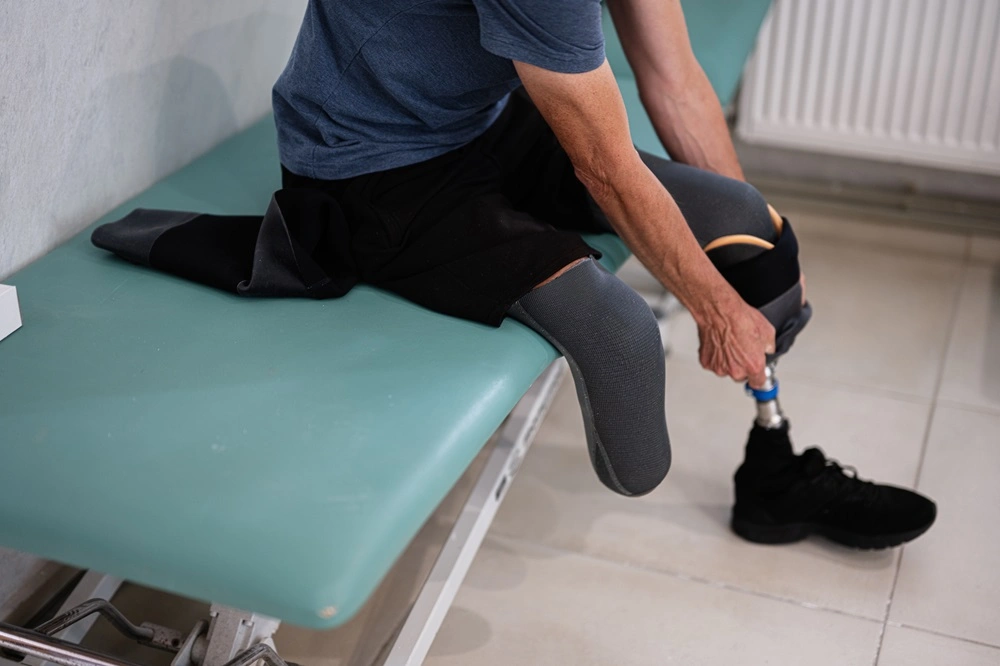
Figure 2. Prosthetic sock adjustment is one common way to accommodate daily changes in socket fit. Image source: PrimeCare Prosthetics.
Taking the Prosthesis Off Can Also Change Limb Volume
An interesting finding from research is how quickly the residual limb can change after the prosthesis is removed. In one study summarized by Sanders and Fatone, residual-limb volume increased by approximately 2.4% to 10.9% during a 35-minute period after socket removal, with much of the increase occurring during the first several minutes.
A separate study involving 16 transtibial prosthesis users found that temporarily removing both the socket and liner during a 30-minute rest produced greater fluid-volume recovery than leaving the prosthesis on. This does not mean everyone should routinely remove their prosthesis for 30 minutes. It demonstrates that the socket itself influences fluid movement and that a measurement taken after the prosthesis has been off for a while may not represent the limb volume that existed while you were walking.
This is also one reason prosthetists ask detailed questions about when discomfort occurs and how long the prosthesis has been worn. Timing matters.
Adjustable Sockets and Vacuum Systems
Newer socket technologies attempt to accommodate volume changes instead of relying entirely on socks. Adjustable panels, mechanical dial systems, inflatable components, and other designs can allow the socket volume to be changed during the day.
In a study of adjustable sockets, releasing socket pressure during rest improved subsequent fluid-volume retention. Returning the socket to a slightly larger setting after release also reduced longer-term fluid loss compared with the projected control condition (Brzostowski et al., 2019). These findings are promising, but they do not mean an adjustable socket is automatically the best solution for every user.
Vacuum-assisted suspension is another strategy intended to improve coupling between the limb and socket and may help manage volume for some users. The systematic-review literature, however, emphasizes that responses vary and the evidence does not support one universal volume-management system for everyone. Socket design should be matched to the person, their limb, their health, their activity level, and their goals.
Health Conditions Can Make Daily Changes More Complicated
Residual-limb volume is influenced by more than the prosthesis. Vascular disease, diabetes, heart and kidney conditions, medications, body weight, hydration, diet, and general fluid balance can all affect swelling and fluid movement. A 2023 systematic review of adjustable socket designs specifically noted diabetes and dialysis among the factors that can contribute to residual-limb volume fluctuation.
For people whose overall fluid status changes substantially during the week, socket fit may be especially difficult to keep consistent. This is not something to solve simply by continually adding socks. Large or unpredictable changes should be discussed with the prosthetist and medical team so that both prosthetic and medical causes are considered.
Longer-term body-weight changes matter as well. Losing or gaining weight can change the amount and distribution of soft tissue in the residual limb. If the socket increasingly requires large adjustments to remain wearable, it may be time for a socket reassessment rather than continuing to compensate indefinitely.
Your Skin Is Giving You Information
Your skin is one of the best early-warning systems for socket-fit problems. Check the residual limb after removing the prosthesis, particularly when the fit has felt different.
Temporary mild redness over areas designed to bear pressure may occur, but redness that does not fade, blisters, open areas, drainage, unusual warmth, darkening, persistent pain, or rapidly worsening irritation should not be ignored. Socket-to-limb volume mismatch is recognized as an important contributor to prosthesis-related skin ulceration.
People with reduced sensation need to be particularly disciplined about visual inspection because pain may not reliably signal tissue damage. A mirror or phone camera can help inspect areas that are difficult to see.
When Sock Management Is No Longer Enough
There is an important difference between normal daily accommodation and trying to rescue a socket that no longer fits. If you are repeatedly adding large amounts of sock ply, constantly changing socks without achieving comfort, developing skin problems, or feeling unstable despite adjustments, the socket may need professional modification or replacement.
Research summarized in the residual-limb volume systematic review found that socket-fit problems became significant enough to stop study participation when some limbs changed by roughly 4% in volume loss or 5% in volume gain over longer periods. Again, these are research observations rather than rules for deciding when you personally need a new socket.
Your prosthetist evaluates more than sock ply. They look at total contact, pressure distribution, suspension, alignment, limb shape, tissue condition, gait, and whether the socket still supports your functional goals.
A Practical Daily Socket-Fit Routine
A useful habit is to treat socket fit as something you monitor throughout the day rather than something you check only when putting the prosthesis on. Pay attention to how deeply you are sitting in the socket, whether the limb is moving, whether pressure has shifted, and whether your gait feels different.
Carry the sock options or adjustment tools recommended by your prosthetist. If you make an adjustment, change one thing at a time and notice what happens. Keeping a short log for a week can be surprisingly useful: note the time, sock ply or socket setting, activity, comfort, and any skin findings.
Do not use socks to cover a wound, fold socks to pad one painful spot unless specifically instructed, or keep adding layers indefinitely to compensate for a socket that has become fundamentally too large. Those approaches can create new pressure points.
What to Tell Your Prosthetist
The more specific you can be, the easier it is for your prosthetist to understand the problem. Instead of saying only, ‘My socket doesn’t fit,’ explain when it changes. Does it feel tight first thing in the morning? Does it become loose after two hours? How many sock ply are you adding? Does the discomfort occur while sitting, standing, or walking? Is the problem worse on dialysis days, hot days, or highly active days? Where exactly do you see redness?
Photographs of skin changes and a short fit log can help identify patterns. Bring the socks and liners you normally use so the prosthetist can evaluate the complete system rather than the socket alone.
Socket fit is not something you are expected to manage perfectly by yourself. Learning your own volume pattern is part of becoming an experienced prosthesis user, but recurring pain, skin damage, or instability requires professional assessment.
The Most Important Point: A Changing Fit Is Real
People sometimes blame themselves when a socket that was comfortable yesterday feels wrong today. Residual-limb volume research makes it clear that these changes are real, measurable, and often unavoidable. Even mature residual limbs continue to fluctuate.
The goal is not to achieve a limb that never changes. The goal is to recognize your pattern, respond appropriately, protect your skin, and work with your prosthetist when ordinary adjustments are no longer enough.
A well-fitting socket should help you trust your prosthesis. If you spend the entire day thinking about pressure, movement, pain, or whether the prosthesis will stay secure, that deserves attention. Small fit changes can have a large impact, and addressing them early can protect comfort, mobility, confidence, and long-term residual-limb health.
Key Data Points
• Residual-limb volume changes as small as about 1% can produce clinically detectable changes in socket fit.
• In mature residual limbs, daily changes continue even after the first 12-18 months following amputation.
• One study found post-doffing volume increases of approximately 2.4% to 10.9% during 35 minutes after socket removal.
• In 28 transtibial prosthesis users, adding a one-ply sock produced fluid-volume changes ranging from -4.0% to +0.8%; removing it produced changes ranging from -1.2% to +2.8%.
• In a socket-release study, 30 minutes of doffing after activity produced an average 5.5% increase in posterior residual-limb fluid volume.
References
Brzostowski, J. T., Larsen, B. G., Youngblood, R. T., Ciol, M. A., Hafner, B. J., Gurrey, C. J., McLean, J. B., Allyn, K. J., & Sanders, J. E. (2019). Adjustable sockets may improve residual limb fluid volume retention in transtibial prosthesis users. Prosthetics and Orthotics International, 43(3), 250-256. https://doi.org/10.1177/0309364618820140
Sanders, J. E., & Fatone, S. (2011). Residual limb volume change: Systematic review of measurement and management. Journal of Rehabilitation Research and Development, 48(8), 949-986. https://doi.org/10.1682/JRRD.2010.09.0189
Sanders, J. E., Harrison, D. S., Allyn, K. J., Myers, T. R., Ciol, M. A., & Tsai, E. C. (2012). How do sock ply changes affect residual-limb fluid volume in people with transtibial amputation? Journal of Rehabilitation Research and Development, 49(2), 241-256. https://doi.org/10.1682/JRRD.2011.02.0022
Youngblood, R. T., Hafner, B. J., Allyn, K. J., Cagle, J. C., Hinrichs, P., Redd, C. B., & Sanders, J. E. (2020). Effects of activity intensity, time, and intermittent doffing on daily limb fluid-volume change in people with transtibial amputation. Prosthetics and Orthotics International, 44(1), 28-38.
Sanders, J. E., et al. (2015). Does temporary socket removal affect residual limb fluid volume of trans-tibial amputees? Prosthetics and Orthotics International.
Diment, L. E., et al. (2023). Adjustable prosthetic sockets: A systematic review of industrial and research design characteristics and their justifications. Journal of NeuroEngineering and Rehabilitation.
Highsmith, M. J., et al. (2016). Interventions to manage residual limb ulceration due to prosthetic use in individuals with lower extremity amputation: A systematic review of the literature. Technology and Innovation, 18(2-3), 115-123.
Educational note: This article is intended for general education and does not replace individualized assessment by a certified prosthetist or healthcare professional.
Understanding Residual-Limb Volume, Daily Fit Changes, and What You Can Do About Them
Limbloss Connection Educational Resource
One of the most frustrating things about wearing a prosthesis is that a socket can feel excellent in the morning and completely different a few hours later. It may become loose, your residual limb may begin moving inside the socket, or an area that felt comfortable earlier may suddenly become sore. On another day, the opposite may happen: the socket feels unusually tight and difficult to put on.
This does not automatically mean the socket was made incorrectly. A prosthetic socket is a relatively fixed structure being worn over living tissue that changes throughout the day. Fluid shifts, activity, pressure from the socket, temperature, health conditions, weight changes, and the age of the amputation can all influence residual-limb size and shape. Research has shown that changes as small as about 1% in residual-limb volume can sometimes produce clinically detectable changes in socket fit (Brzostowski et al., 2019).
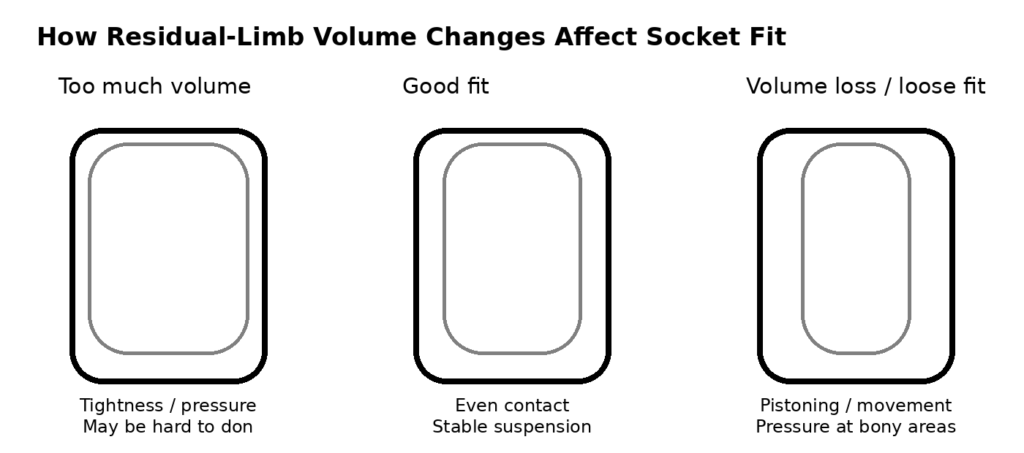
Figure 1. A simplified illustration of how changes in residual-limb volume can change socket fit.
Your Residual Limb Is Living Tissue, Not a Fixed Shape
A residual limb contains skin, fat, muscle, blood vessels, lymphatic tissue, and extracellular fluid. All of these tissues respond to pressure, movement, circulation, hydration, temperature, and activity. The socket, by contrast, cannot automatically change size unless it has an adjustable design. This mismatch between a changing body and a fixed socket is one of the central challenges of prosthetic fitting.
The largest changes generally occur during the months after an amputation. Post-operative swelling gradually decreases and muscles can change in size as healing and rehabilitation progress. A major systematic review found that residual-limb volume can continue changing during the first 12 to 18 months, although the rate usually slows over time. Importantly, even a mature residual limb can continue to fluctuate from morning to evening and from one day to another (Sanders & Fatone, 2011).
Most of the quantitative research in this area has involved people with transtibial, or below-knee, amputations. The basic principle that soft-tissue volume can change and affect socket fit also matters for other levels of limb loss, including upper-limb prosthetic sockets, but the exact numbers should not automatically be assumed to apply to every amputation level.
Why a Socket Often Feels Tighter in the Morning
For many prosthesis users, the residual limb is relatively full when they first get up. During sleep, the limb is not spending hours inside a weight-bearing socket. Once the prosthesis is donned and normal daily activity begins, pressure and shear forces from the socket can move fluid out of the soft tissues.
This is why someone may put on a prosthesis in the morning with no socks—or only a thin sock—and need additional sock ply later. Research using in-socket bioimpedance measurements has confirmed that many transtibial prosthesis users lose residual-limb fluid volume as the day progresses, with the rate of loss often being greater earlier in the day than later (Youngblood et al., 2020).
Not everyone follows this pattern. Some people swell during the day. Venous disease, vascular health, the use of a shrinker at night, suspension method, activity, medications, and other medical conditions can influence whether a limb gains or loses volume. This is why your own pattern matters more than a rule such as ‘everyone needs more socks in the afternoon.’
How Much Change Is Enough to Affect Fit?
The percentages may sound small, but socket fit is extremely sensitive. Research has reported that an oversized socket of only about 1% can create a clinically detectable fit change. Earlier clinical observations summarized in a systematic review suggested that a transition from a good fit toward an acceptable fit could occur at roughly 5% volume loss, while larger losses could produce an unacceptable fit. Volume gain can become problematic at even smaller percentages because the socket may become too tight (Sanders & Fatone, 2011).
These figures are not personal thresholds. A person who begins the day with a borderline fit may notice problems after a much smaller change. Bone shape, tissue thickness, scars, sensation, suspension, socket design, and activity all influence how much change a particular person can tolerate.
The practical lesson is that ‘only a little looser’ or ‘only a little tighter’ can matter. You do not need a dramatic change in circumference before the mechanics inside the socket begin to change.
What Happens When Your Limb Loses Volume
When the residual limb becomes smaller relative to the socket, the limb may sink farther into it. Prosthetists often call excessive up-and-down movement pistoning. You may feel movement when taking a step, hear air entering the socket, notice that the prosthesis feels less connected to you, or feel that you have to work harder to control it.
Volume loss also changes where pressure is concentrated. Research has shown that a looser socket can increase stress around bony areas such as the front of the distal tibia and fibular head in transtibial users. Repeated movement creates friction and shear, increasing the risk of redness, blisters, skin injury, and pain (Sanders et al., 2012).
A loose socket can also change your gait. If you do not trust the connection between your body and prosthesis, you may shorten your step, walk more cautiously, compensate at the hip, or rely more heavily on the other limb. Over time, a fit problem can become a mobility problem.
What Happens When Your Limb Gains Volume
A socket can also become too tight. You may have difficulty getting fully into the socket, feel excessive pressure, notice throbbing, or experience discomfort that increases instead of settling after you begin walking.
Excessive compression can be particularly concerning for people with vascular disease, diabetes, reduced sensation, or fragile skin. A person with neuropathy may not receive the same warning pain that someone with normal sensation would feel. That makes visual skin inspection especially important.
Do not try to force yourself into a socket that is clearly too tight simply because it fit yesterday. Persistent tightness, colour changes, unusual swelling, wounds, or circulation concerns deserve assessment by your prosthetist and, when appropriate, your healthcare team.
Activity Can Change Fit
Walking places repeated mechanical pressure on the residual limb. Fluid can be displaced from the soft tissues as the limb repeatedly loads and unloads inside the socket. A six-hour study of 13 transtibial prosthesis users found that the rate of fluid-volume loss was higher earlier in the session than later, reinforcing that time and activity interact rather than producing a perfectly steady change (Youngblood et al., 2020).
The response is highly individual. Two people can perform the same amount of walking and experience very different volume changes. Vascular health, tissue characteristics, socket design, suspension, and baseline fit all influence the response.
This explains why a socket may behave differently on a quiet day at home compared with a day involving shopping, work, physiotherapy, or prolonged walking. Tracking what you were doing when fit changed can provide useful information to your prosthetist.
Prosthetic Socks: A Simple Tool, but Not a Guessing Game
Prosthetic socks are commonly used to take up space when the residual limb loses volume. Sock thickness is often described in ply. The goal is not to add the largest number possible; it is to restore appropriate contact and stability without creating excessive pressure.
A study of 28 people with transtibial amputation measured fluid-volume changes after adding and removing a one-ply sock. After sock addition, changes ranged from a 4.0% decrease to a 0.8% increase, with a mean decrease of 0.9%. After the sock was removed, changes ranged from a 1.2% decrease to a 2.8% increase, with a mean increase of 0.5% (Sanders et al., 2012). The wide variation is important: people do not all respond to sock changes in the same way.
Adding socks is therefore not simply filling empty space. The added material also changes pressure on the limb and can itself influence fluid movement. People with arterial disease, diabetes, obesity, or other circulation concerns may respond differently and should follow the individualized guidance of their prosthetist and healthcare team.
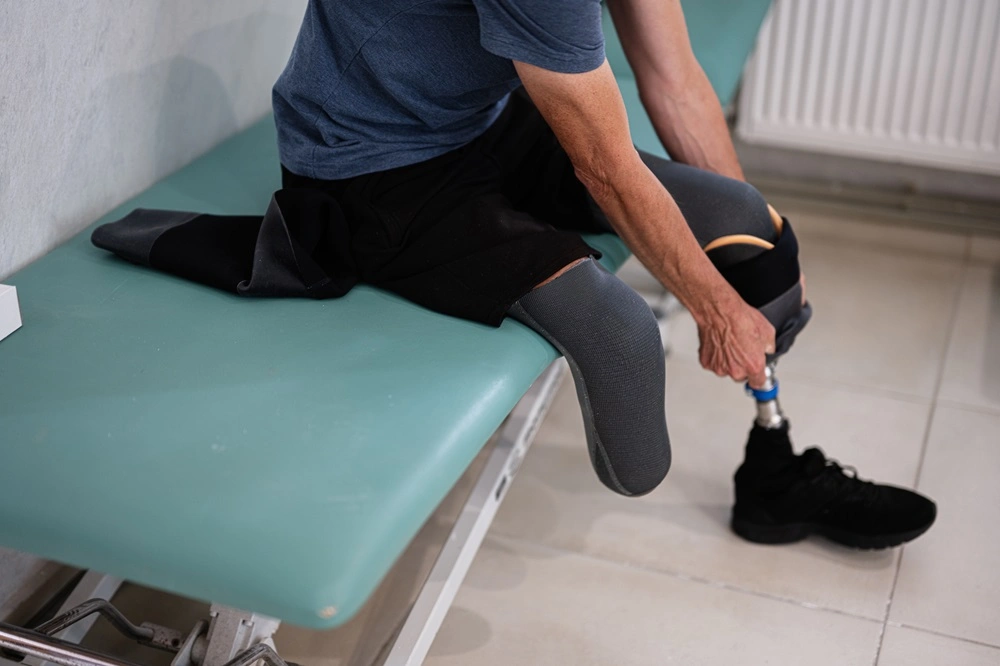
Figure 2. Prosthetic sock adjustment is one common way to accommodate daily changes in socket fit. Image source: PrimeCare Prosthetics.
Taking the Prosthesis Off Can Also Change Limb Volume
An interesting finding from research is how quickly the residual limb can change after the prosthesis is removed. In one study summarized by Sanders and Fatone, residual-limb volume increased by approximately 2.4% to 10.9% during a 35-minute period after socket removal, with much of the increase occurring during the first several minutes.
A separate study involving 16 transtibial prosthesis users found that temporarily removing both the socket and liner during a 30-minute rest produced greater fluid-volume recovery than leaving the prosthesis on. This does not mean everyone should routinely remove their prosthesis for 30 minutes. It demonstrates that the socket itself influences fluid movement and that a measurement taken after the prosthesis has been off for a while may not represent the limb volume that existed while you were walking.
This is also one reason prosthetists ask detailed questions about when discomfort occurs and how long the prosthesis has been worn. Timing matters.
Adjustable Sockets and Vacuum Systems
Newer socket technologies attempt to accommodate volume changes instead of relying entirely on socks. Adjustable panels, mechanical dial systems, inflatable components, and other designs can allow the socket volume to be changed during the day.
In a study of adjustable sockets, releasing socket pressure during rest improved subsequent fluid-volume retention. Returning the socket to a slightly larger setting after release also reduced longer-term fluid loss compared with the projected control condition (Brzostowski et al., 2019). These findings are promising, but they do not mean an adjustable socket is automatically the best solution for every user.
Vacuum-assisted suspension is another strategy intended to improve coupling between the limb and socket and may help manage volume for some users. The systematic-review literature, however, emphasizes that responses vary and the evidence does not support one universal volume-management system for everyone. Socket design should be matched to the person, their limb, their health, their activity level, and their goals.
Health Conditions Can Make Daily Changes More Complicated
Residual-limb volume is influenced by more than the prosthesis. Vascular disease, diabetes, heart and kidney conditions, medications, body weight, hydration, diet, and general fluid balance can all affect swelling and fluid movement. A 2023 systematic review of adjustable socket designs specifically noted diabetes and dialysis among the factors that can contribute to residual-limb volume fluctuation.
For people whose overall fluid status changes substantially during the week, socket fit may be especially difficult to keep consistent. This is not something to solve simply by continually adding socks. Large or unpredictable changes should be discussed with the prosthetist and medical team so that both prosthetic and medical causes are considered.
Longer-term body-weight changes matter as well. Losing or gaining weight can change the amount and distribution of soft tissue in the residual limb. If the socket increasingly requires large adjustments to remain wearable, it may be time for a socket reassessment rather than continuing to compensate indefinitely.
Your Skin Is Giving You Information
Your skin is one of the best early-warning systems for socket-fit problems. Check the residual limb after removing the prosthesis, particularly when the fit has felt different.
Temporary mild redness over areas designed to bear pressure may occur, but redness that does not fade, blisters, open areas, drainage, unusual warmth, darkening, persistent pain, or rapidly worsening irritation should not be ignored. Socket-to-limb volume mismatch is recognized as an important contributor to prosthesis-related skin ulceration.
People with reduced sensation need to be particularly disciplined about visual inspection because pain may not reliably signal tissue damage. A mirror or phone camera can help inspect areas that are difficult to see.
When Sock Management Is No Longer Enough
There is an important difference between normal daily accommodation and trying to rescue a socket that no longer fits. If you are repeatedly adding large amounts of sock ply, constantly changing socks without achieving comfort, developing skin problems, or feeling unstable despite adjustments, the socket may need professional modification or replacement.
Research summarized in the residual-limb volume systematic review found that socket-fit problems became significant enough to stop study participation when some limbs changed by roughly 4% in volume loss or 5% in volume gain over longer periods. Again, these are research observations rather than rules for deciding when you personally need a new socket.
Your prosthetist evaluates more than sock ply. They look at total contact, pressure distribution, suspension, alignment, limb shape, tissue condition, gait, and whether the socket still supports your functional goals.
A Practical Daily Socket-Fit Routine
A useful habit is to treat socket fit as something you monitor throughout the day rather than something you check only when putting the prosthesis on. Pay attention to how deeply you are sitting in the socket, whether the limb is moving, whether pressure has shifted, and whether your gait feels different.
Carry the sock options or adjustment tools recommended by your prosthetist. If you make an adjustment, change one thing at a time and notice what happens. Keeping a short log for a week can be surprisingly useful: note the time, sock ply or socket setting, activity, comfort, and any skin findings.
Do not use socks to cover a wound, fold socks to pad one painful spot unless specifically instructed, or keep adding layers indefinitely to compensate for a socket that has become fundamentally too large. Those approaches can create new pressure points.
What to Tell Your Prosthetist
The more specific you can be, the easier it is for your prosthetist to understand the problem. Instead of saying only, ‘My socket doesn’t fit,’ explain when it changes. Does it feel tight first thing in the morning? Does it become loose after two hours? How many sock ply are you adding? Does the discomfort occur while sitting, standing, or walking? Is the problem worse on dialysis days, hot days, or highly active days? Where exactly do you see redness?
Photographs of skin changes and a short fit log can help identify patterns. Bring the socks and liners you normally use so the prosthetist can evaluate the complete system rather than the socket alone.
Socket fit is not something you are expected to manage perfectly by yourself. Learning your own volume pattern is part of becoming an experienced prosthesis user, but recurring pain, skin damage, or instability requires professional assessment.
The Most Important Point: A Changing Fit Is Real
People sometimes blame themselves when a socket that was comfortable yesterday feels wrong today. Residual-limb volume research makes it clear that these changes are real, measurable, and often unavoidable. Even mature residual limbs continue to fluctuate.
The goal is not to achieve a limb that never changes. The goal is to recognize your pattern, respond appropriately, protect your skin, and work with your prosthetist when ordinary adjustments are no longer enough.
A well-fitting socket should help you trust your prosthesis. If you spend the entire day thinking about pressure, movement, pain, or whether the prosthesis will stay secure, that deserves attention. Small fit changes can have a large impact, and addressing them early can protect comfort, mobility, confidence, and long-term residual-limb health.
Key Data Points
• Residual-limb volume changes as small as about 1% can produce clinically detectable changes in socket fit.
• In mature residual limbs, daily changes continue even after the first 12-18 months following amputation.
• One study found post-doffing volume increases of approximately 2.4% to 10.9% during 35 minutes after socket removal.
• In 28 transtibial prosthesis users, adding a one-ply sock produced fluid-volume changes ranging from -4.0% to +0.8%; removing it produced changes ranging from -1.2% to +2.8%.
• In a socket-release study, 30 minutes of doffing after activity produced an average 5.5% increase in posterior residual-limb fluid volume.
References
Brzostowski, J. T., Larsen, B. G., Youngblood, R. T., Ciol, M. A., Hafner, B. J., Gurrey, C. J., McLean, J. B., Allyn, K. J., & Sanders, J. E. (2019). Adjustable sockets may improve residual limb fluid volume retention in transtibial prosthesis users. Prosthetics and Orthotics International, 43(3), 250-256. https://doi.org/10.1177/0309364618820140
Sanders, J. E., & Fatone, S. (2011). Residual limb volume change: Systematic review of measurement and management. Journal of Rehabilitation Research and Development, 48(8), 949-986. https://doi.org/10.1682/JRRD.2010.09.0189
Sanders, J. E., Harrison, D. S., Allyn, K. J., Myers, T. R., Ciol, M. A., & Tsai, E. C. (2012). How do sock ply changes affect residual-limb fluid volume in people with transtibial amputation? Journal of Rehabilitation Research and Development, 49(2), 241-256. https://doi.org/10.1682/JRRD.2011.02.0022
Youngblood, R. T., Hafner, B. J., Allyn, K. J., Cagle, J. C., Hinrichs, P., Redd, C. B., & Sanders, J. E. (2020). Effects of activity intensity, time, and intermittent doffing on daily limb fluid-volume change in people with transtibial amputation. Prosthetics and Orthotics International, 44(1), 28-38.
Sanders, J. E., et al. (2015). Does temporary socket removal affect residual limb fluid volume of trans-tibial amputees? Prosthetics and Orthotics International.
Diment, L. E., et al. (2023). Adjustable prosthetic sockets: A systematic review of industrial and research design characteristics and their justifications. Journal of NeuroEngineering and Rehabilitation.
Highsmith, M. J., et al. (2016). Interventions to manage residual limb ulceration due to prosthetic use in individuals with lower extremity amputation: A systematic review of the literature. Technology and Innovation, 18(2-3), 115-123.
Educational note: This article is intended for general education and does not replace individualized assessment by a certified prosthetist or healthcare professional.