For someone exploring an upper-limb prosthesis, one of the biggest decisions may be whether to use a body-powered system, a myoelectric system, or a combination of technologies. Both approaches can provide useful function, but they work very differently and each has strengths and limitations.
A body-powered prosthesis uses the person’s own body movement to operate a mechanical cable system. A myoelectric prosthesis uses electrical signals generated by muscles to control battery-powered components.
Neither option is automatically better. The right choice depends on the level of limb loss, available muscle function, strength and range of motion, work and recreational activities, comfort, weight, durability, maintenance, appearance, funding, and personal preference.
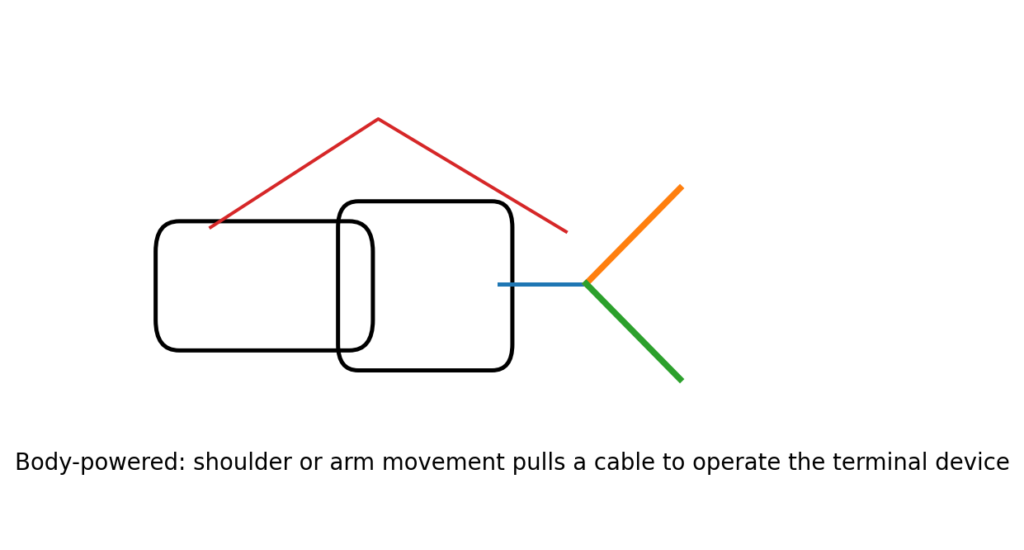
Illustration: the basic differences between body-powered and myoelectric control.
What Is a Body-Powered Prosthesis?
Illustration: a body-powered upper-limb prosthesis using a harness and cable system.
A body-powered prosthesis is operated mechanically. A harness and cable system captures movement from the shoulder, upper arm, chest, or residual limb. When the user moves, tension is placed on the cable and that movement operates a terminal device such as a hook, hand, or prehensor.
The principle is similar to a bicycle handbrake: movement pulls a cable, and the cable creates movement at the other end.
Body-powered systems can be used at different levels of upper-limb loss. The exact harnessing and control strategy depend on how much of the arm remains and which joints and muscles are available.
Voluntary-Opening and Voluntary-Closing Devices
Body-powered terminal devices can operate in different ways. With a voluntary-opening device, the user applies cable force to open the terminal device, while elastic elements help it close. With a voluntary-closing device, the user applies force to close the device around an object.
Some users value voluntary-closing systems because the amount of cable tension can provide useful information about how firmly an object is being held.
Advantages of Body-Powered Arms
● Generally lighter than many electrically powered systems.
● Mechanical systems can be durable and dependable.
● No battery charging is required for basic body-powered systems.
● Repairs may be simpler than repairs to complex electronic components.
● Cable tension can provide a form of feedback about grip and movement.
● Hooks can provide a clear view of the object being grasped.
● Some designs are well suited to demanding work environments.
● Initial cost is often lower than for advanced myoelectric systems.
For someone who values reliability, low weight, straightforward maintenance, or strong mechanical control, a body-powered system can be an excellent option.
Limitations of Body-Powered Arms
● A harness and cable system is usually required.
● Operating the prosthesis depends on sufficient strength and range of motion.
● Repeated shoulder or upper-body movement can be tiring for some users.
● Harnessing may feel restrictive or uncomfortable.
● Cables can sometimes interfere with clothing.
● Some people prefer the appearance of an electric hand or a system without visible cables.
● Certain movements may feel less intuitive until the user develops experience.
A body-powered prosthesis should be properly fitted and trained. If excessive shoulder or body movement is required, the user should discuss this with the prosthetist and occupational therapist.
What Is a Myoelectric Prosthesis?
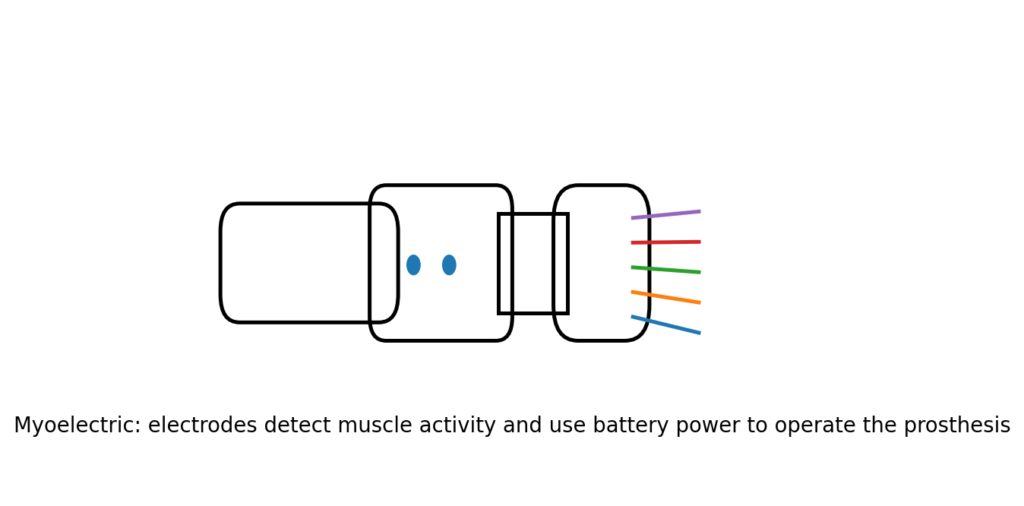
Illustration: a myoelectric prosthesis using electrodes to detect muscle signals.
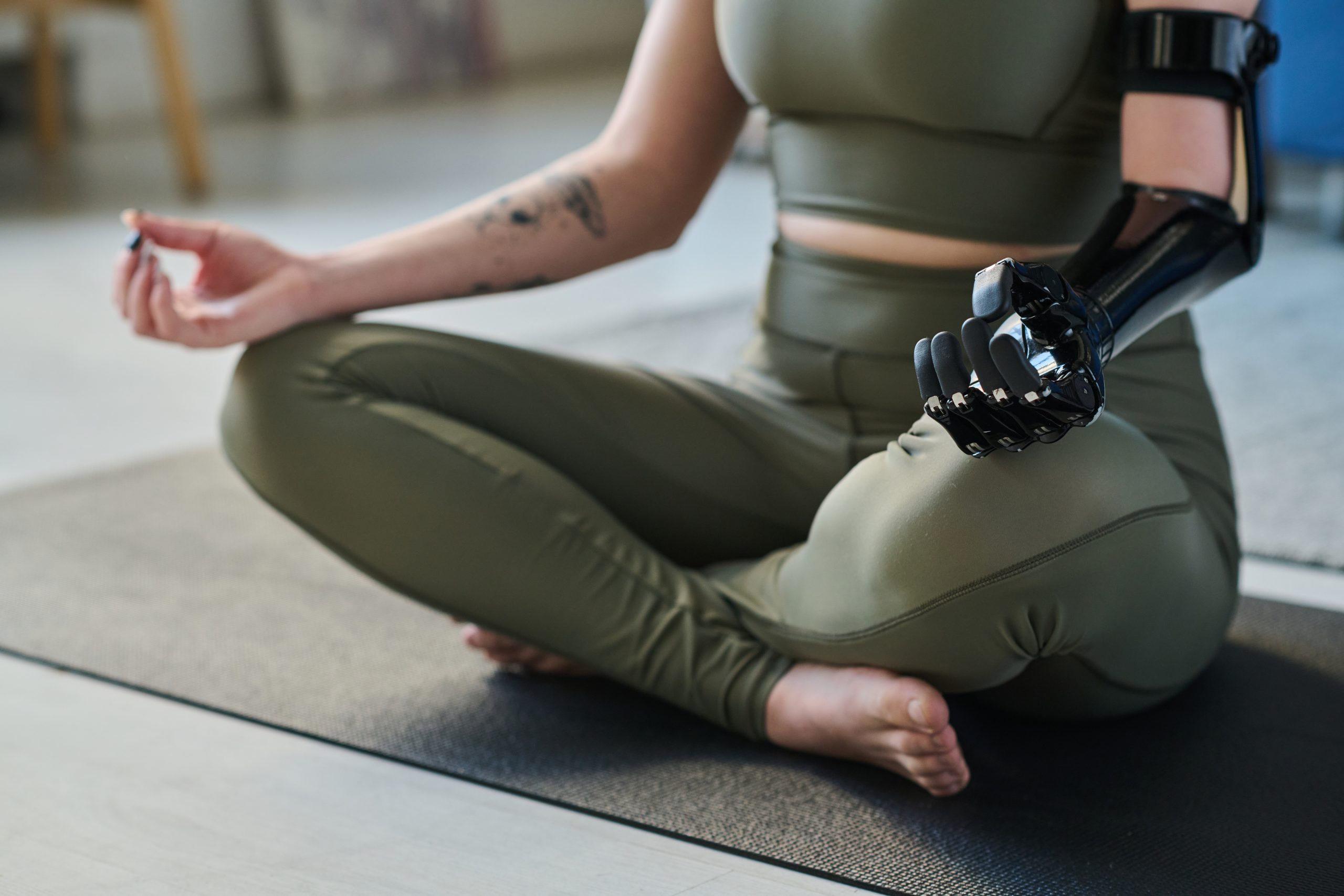
A myoelectric prosthesis uses electrical activity produced by muscles to control powered components. Electrodes positioned against the skin detect these signals and send them to the prosthetic control system.
The prosthesis then uses battery power to operate a hand, hook, wrist, elbow, or another powered component.
For example, a person may contract one muscle group to open the hand and another to close it. Depending on the system, additional muscle patterns, switches, sensors, or control methods can be used to access more functions.
The user does not need to produce a large visible muscle movement. The system is detecting the electrical activity associated with muscle contraction.
Advantages of Myoelectric Arms
● Powered movement can reduce the physical effort needed to open and close a terminal device.
● Some configurations do not require the traditional harness and cable used with body-powered systems.
● Electric hands and hooks can provide useful grip force.
● Multi-articulating hands may provide several programmed grip patterns.
● Powered wrists and elbows can expand positioning options.
● Some users prefer the appearance of myoelectric hands.
● Control can feel more intuitive for some people after appropriate training.
For the right person, myoelectric control can provide a useful combination of powered movement, appearance, and functional options.
Limitations of Myoelectric Arms
● Electronic components and batteries can add weight.
● The prosthesis must be charged.
● Purchase and repair costs can be substantially higher.
● Repairs may require specialized service.
● Electrode contact can be affected by socket fit, sweating, skin conditions, or changes in residual-limb volume.
● Some devices have limitations around water, dust, or other environmental exposure.
● More functions can create a steeper learning curve.
● Funding or insurance may restrict access to certain components.
Advanced technology is only useful if the user can comfortably wear and reliably control it.
Weight: A Major Difference
Weight is one of the most important practical differences between many body-powered and myoelectric systems.
A body-powered device can often be relatively lightweight because it does not require motors and batteries for basic operation. Myoelectric systems may include batteries, motors, sensors, electronics, powered wrists, and multi-articulating hands.
The difference can become especially important for people with higher levels of limb loss because the prosthesis may also need to replace an elbow or additional joints.
When comparing systems, do not simply hold the prosthesis for a few seconds. When possible, evaluate how the complete system feels during meaningful activities and over a longer period.
Control and Feedback
The two systems provide very different control experiences.
Body-powered users can often feel changes in cable tension through the harness. This mechanical feedback can help some users judge how the terminal device is behaving without relying entirely on vision.
Myoelectric systems do not normally provide the same cable-tension feedback. Users may rely more heavily on vision, sound, experience, and the behaviour of the powered device.
Research into sensory feedback continues, but the practical experience varies considerably between systems and users.
Hands vs. Hooks
The comparison is not simply body-powered hook versus myoelectric hand.
Body-powered systems can use hands, hooks, and other terminal devices. Myoelectric systems can also use powered hands or powered hooks.
Hooks can be highly functional because the user can see the object between the tips. They may be particularly useful for precision tasks, tools, or work environments.
Electric hands may provide different grasp patterns and an appearance some users prefer.
Some people use interchangeable terminal devices because no single hand or hook is ideal for every task.
Appearance
Appearance is a legitimate consideration in prosthetic selection, but preferences vary widely.
Some users want a prosthesis that resembles a biological arm and hand. Others prefer an openly mechanical or high-tech appearance. Some care very little about appearance and prioritize function, durability, or weight.
The right choice is the one that makes sense for the person wearing it.
Durability and Work Environments
The environment where the prosthesis will be used should influence the decision.
Someone working around dust, dirt, moisture, tools, machinery, or heavy physical tasks may have different requirements from someone primarily using a prosthesis in an office or home environment.
Body-powered systems are often valued for mechanical simplicity and ease of repair. Myoelectric systems vary greatly in their resistance to water, dust, impact, and environmental exposure.
Ask the prosthetist for the exact environmental rating and restrictions of any component being considered.
Battery Life and Charging
Battery management is part of living with a myoelectric prosthesis.
Battery life varies according to the components, how frequently powered functions are used, and the age and condition of the battery.
Ask:
● How long should a charge last during typical use?
● How long does charging take?
● Can a spare battery be carried?
● What happens if the battery dies while I am away from home?
● How much does a replacement battery cost?
● Can the prosthesis be used safely while travelling?
A body-powered system does not require charging for its basic mechanical functions, which can be an advantage for some users.
Sweating and Electrode Contact
Myoelectric control depends on reliable detection of muscle signals. The electrodes must maintain appropriate contact with the skin.
Sweating, changes in residual-limb volume, socket movement, or skin irritation can sometimes affect signal quality.
If a myoelectric prosthesis becomes inconsistent, the problem may involve the socket or electrode interface rather than the electronic hand itself.
This is one reason socket fit remains critical regardless of how sophisticated the prosthetic components are.
Training and the Learning Curve
Both systems require training.
With a body-powered prosthesis, the user needs to learn how to create the correct cable movement while positioning the arm and terminal device efficiently.
With a myoelectric prosthesis, the user needs to learn how to produce consistent muscle signals, open and close the terminal device, switch functions, and control grip appropriately.
Occupational therapy can help with:
● Putting on and removing the prosthesis.
● Controlling the terminal device.
● Using both arms together during everyday tasks.
● Reducing unnecessary compensatory movements.
● Eating and food preparation.
● Dressing and personal care.
● Work-related activities.
● Using tools and household objects.
● Driving-related tasks when appropriate.
● Sports and recreational activities.
Which Is Easier to Use?
There is no universal answer.
A myoelectric hand may appear easier because a muscle contraction can trigger powered movement, but controlling several functions can require considerable practice.
A body-powered device may appear mechanically simple, but it still requires coordination, strength, range of motion, and training.
The best way to judge ease of use is to evaluate the system in activities that actually matter to you.
Cost and Funding
Cost can be a significant difference between the two approaches.
Body-powered systems generally have a lower initial cost and simpler repair requirements. Myoelectric systems can become considerably more expensive as powered wrists, elbows, multi-articulating hands, sensors, batteries, and advanced control systems are added.
Funding varies by province, country, insurer, workplace program, veterans’ program, and individual circumstances.
Before making a decision, ask for a written estimate that explains:
● The complete cost of the prosthesis.
● What is covered by public funding or insurance.
● Your out-of-pocket responsibility.
● Repair and maintenance costs.
● Battery replacement costs.
● Replacement gloves or cosmetic coverings.
● Warranty coverage.
● Expected future replacement costs.
What About a Hybrid Prosthesis?
The decision does not always have to be entirely body-powered or entirely myoelectric.
A hybrid system combines technologies. This can be especially useful for some people with above-elbow limb loss who need to control several components.
For example, body movement might be used to control or position an elbow while myoelectric signals operate the terminal device.
A hybrid design can sometimes provide a practical balance between weight, control, power, and complexity.
Body-Powered May Be a Better Fit When…
● You value low weight and mechanical simplicity.
● You want a device that does not need charging.
● You work in an environment where durability is especially important.
● You value cable-tension feedback.
● You prefer a hook or mechanical terminal device for precise tasks.
● You want repairs to be as straightforward as possible.
● Cost or funding makes an advanced electric system impractical.
● You have the strength and range of motion needed to operate the system comfortably.
Myoelectric May Be a Better Fit When…
● You want powered opening and closing of the terminal device.
● You have usable muscle signals that can reliably control the system.
● You want to reduce the body movement required to operate a cable system.
● You would benefit from multiple grip patterns or powered wrist functions.
● You prefer the appearance or configuration of an electric hand.
● You are comfortable managing batteries and charging.
● Your work and environment are compatible with the electronic components.
● Funding is available for the system and its ongoing maintenance.
Questions to Ask Your Prosthetist
About Body-Powered Systems
● What body movements will I need to operate the prosthesis?
● How much force is required?
● What type of harness would I wear?
● Can I try both a hook and a hand?
● Would you recommend voluntary-opening or voluntary-closing control for me?
● How much maintenance will the cable system require?
About Myoelectric Systems
● Where will the electrodes be positioned?
● How strong and consistent are my muscle signals?
● How many functions will I realistically be able to control?
● How long does the battery last?
● What happens if sweating affects electrode contact?
● Is the system water-resistant or waterproof?
● What are the repair and replacement costs?
About Both
● Can I trial each system before making a decision?
● Which system is lighter?
● Which would work better for my job and hobbies?
● What are the expected maintenance costs over several years?
● Can terminal devices be interchanged?
● Would a hybrid system make sense for me?
● How much occupational therapy will I need?
Try the Technology Whenever Possible
A brochure, video, or demonstration cannot tell you exactly how a prosthesis will feel on your body.
When possible, trial different systems and perform realistic tasks. Pick up small objects. Carry something. Open a container. Use a utensil. Manipulate a phone. Put on a jacket. Try a work-related activity.
Pay attention to more than whether you can complete the task. Consider the effort required, the weight of the device, comfort, speed, confidence, and how much concentration is necessary.
You May Prefer More Than One Solution
Some people eventually discover that they do not want to choose only one technology.
A body-powered prosthesis might be preferred for work or demanding activities, while a myoelectric hand may be preferred for other parts of daily life. An activity-specific device may be added for sports or hobbies.
The objective is not to prove that one technology is superior. The objective is to build a set of tools that supports the life you want to live.
Learning From Other People Living With Upper-Limb Loss
Prosthetists and occupational therapists can explain the clinical and technical differences between body-powered and myoelectric systems. People who use these devices every day can provide another kind of information.
They can talk about harness comfort, battery charging, sweating, repairs, clothing, travel, work, durability, grip selection, and which prosthesis they actually reach for when they leave the house.
Limbloss Connection provides opportunities for people living with limb loss and limb difference to connect, share experiences, and learn from one another.
Peer experience should complement professional advice rather than replace it. The best decision is one made with good clinical information, realistic expectations, and a clear understanding of your own priorities.
The Better Question Is: Which One Works Better for You?
Body-powered and myoelectric prostheses approach the same challenge in very different ways.
Body-powered systems emphasize mechanical control, simplicity, durability, low weight, and cable feedback. Myoelectric systems use muscle signals and battery power to provide powered movement and additional control options.
Neither technology wins in every category.
The right choice is the one that provides the best balance of comfort, function, reliability, effort, maintenance, appearance, and cost for your life.
Understanding those trade-offs allows you to work with your prosthetist and rehabilitation team to make a decision based not on which prosthesis is the most advanced, but on which prosthesis is most useful to you.