Choosing a prosthetic foot can be confusing, particularly when you are receiving your first prosthesis. There are many different designs, manufacturers, materials, and technologies, and the terminology can quickly become overwhelming.
A prosthetic foot is much more than the part at the bottom of a prosthetic leg. It can influence stability, balance, walking speed, comfort, energy use, the ability to walk on uneven surfaces, and how naturally the prosthesis responds during everyday movement.
There is no single prosthetic foot that is best for everyone. The right choice depends on your level of limb loss, activity level, health, strength, balance, lifestyle, goals, environment, and funding.
Understanding the major categories of prosthetic feet can help you have a more informed conversation with your prosthetist.
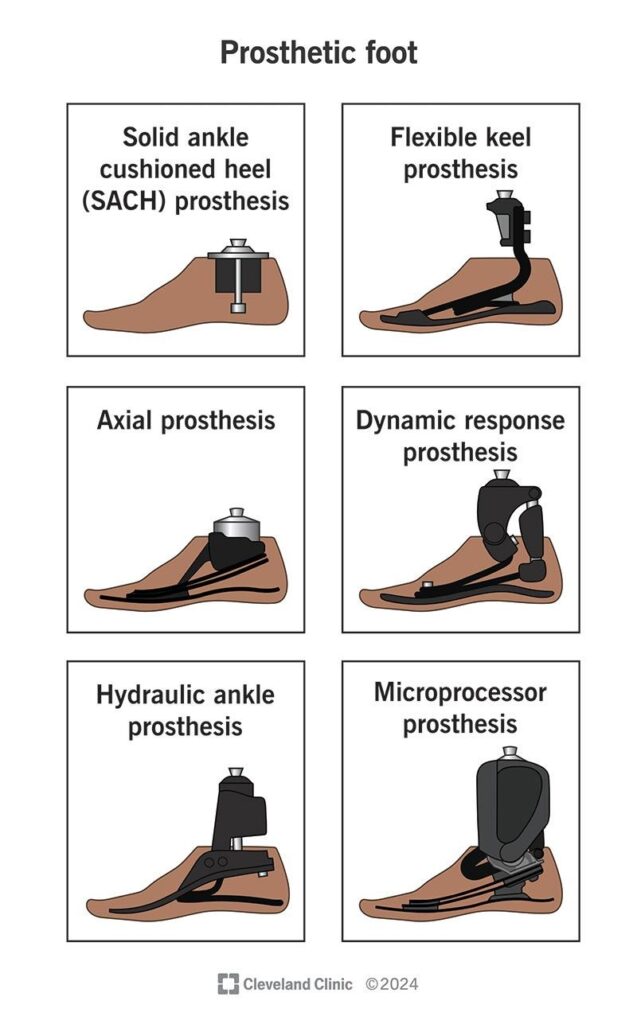
Common categories of prosthetic feet.
Image source: Cleveland Clinic
Why the Prosthetic Foot Matters
During walking, a biological foot performs several jobs. It absorbs impact, adapts to the ground, provides stability, stores and releases energy, and helps move the body forward.
A prosthetic foot attempts to reproduce some of these functions mechanically or electronically. Different designs emphasize different priorities.
For example, one person may need maximum stability for walking around the home. Another may need a foot that performs well on uneven outdoor surfaces. Someone else may want greater energy return for an active lifestyle.
This is why prosthetic feet should be selected according to the person using them rather than simply according to which technology is newest.
Understanding Activity Levels
Prosthetic components are often selected partly according to a person’s functional or activity level. Your prosthetist may discuss classifications sometimes referred to as K-levels or mobility levels.
These classifications are intended to describe your current or potential ability to move through different environments. They can influence which components may be considered appropriate and, depending on the funding system, which components may be covered.
Activity level is only one part of the decision. Your prosthetist should also consider your goals, medical condition, balance, strength, residual limb, living environment, and the activities that matter to you.
SACH Feet
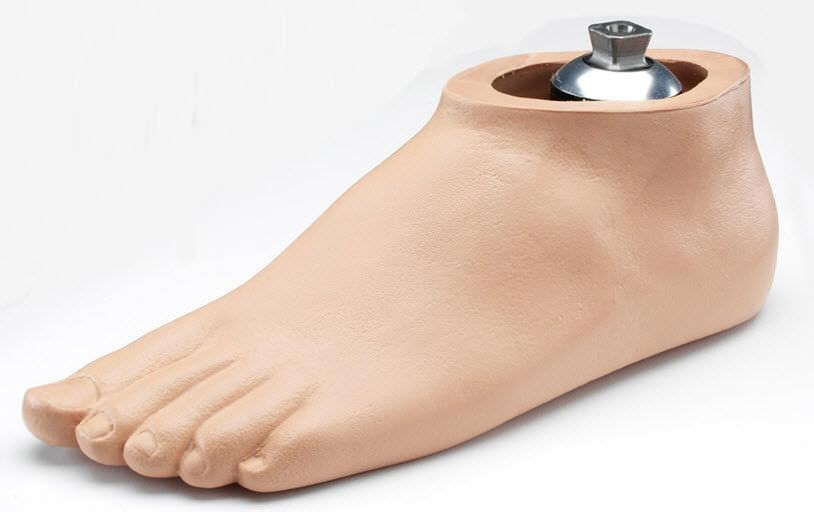
Example of a SACH (Solid Ankle Cushioned Heel) prosthetic foot.
Image source: PhysioStudent
Solid Ankle Cushioned Heel
The SACH foot is one of the simplest and most established prosthetic foot designs. SACH stands for Solid Ankle Cushioned Heel.
The foot does not contain an articulated ankle joint. Instead, cushioning in the heel compresses when the heel contacts the ground, helping absorb some impact and allowing the foot to move toward a stable position.
SACH feet are generally simple, durable, relatively lightweight, and lower in cost than many advanced prosthetic feet.
They may be appropriate for people whose priorities include stability, simplicity, and basic household or community walking.
Potential advantages include:
● Simple design
● Relatively low maintenance
● Good basic stability
● Generally lightweight
● Often less expensive than more advanced feet
● Can be appropriate for lower-activity users
Potential limitations include:
● Limited ability to adapt to uneven terrain
● Little or no dynamic energy return
● Less natural movement than more advanced designs
● May not meet the needs of highly active users
Simple does not mean inferior. For the right person, reliability and stability may be more valuable than advanced technology.
Single-Axis Feet
A single-axis prosthetic foot contains a mechanical ankle that allows movement primarily in one plane, generally allowing the foot to move upward and downward.
This movement can help the foot reach the ground more quickly after heel contact, which may improve stability for some users.
Potential advantages include:
● Can provide good stability during early stance
● Allows some ankle movement
● May help certain users feel more secure during walking
Potential limitations include:
● Usually heavier than a basic SACH foot
● Mechanical parts may require more maintenance
● Limited side-to-side adaptation
● May not provide the energy return desired by more active users
Multi-Axis Feet
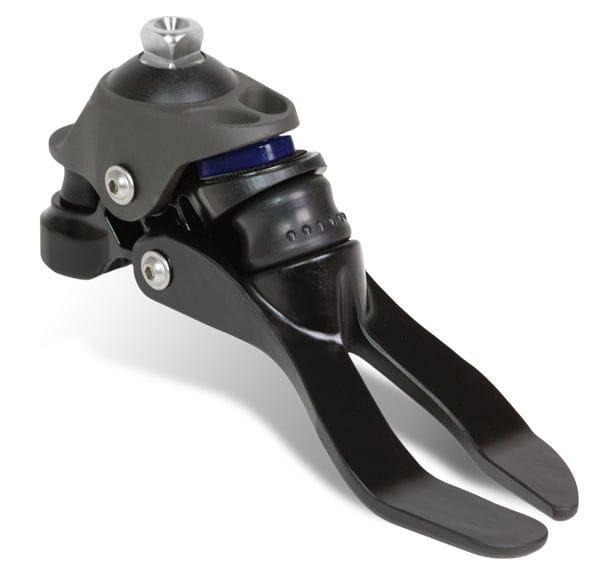
Example of a multi-axial prosthetic foot.
Image source: MedicalExpo / College Park
Multi-axis feet allow movement in more than one direction. In addition to upward and downward motion, they may permit some side-to-side movement and rotation.
This can help the prosthesis adapt when walking across uneven surfaces, slopes, grass, gravel, or other environments where the ground is not perfectly flat.
Potential advantages include:
● Better accommodation of uneven terrain
● Can reduce forces transferred to the residual limb
● May feel more natural on slopes or irregular surfaces
● Allows movement in multiple directions
Potential limitations include:
● May be heavier or more complex than simpler designs
● Some designs may provide less energy return than high-performance dynamic-response feet
● More moving components can mean additional maintenance depending on the design
Flexible-Keel Feet
Flexible-keel feet use materials that bend or deform during walking. This flexibility can allow smoother movement from heel contact through the end of the step.
They can offer more movement than a rigid basic foot while remaining relatively straightforward.
The amount of flexibility and performance varies considerably between products, so two feet in this general category may feel quite different.
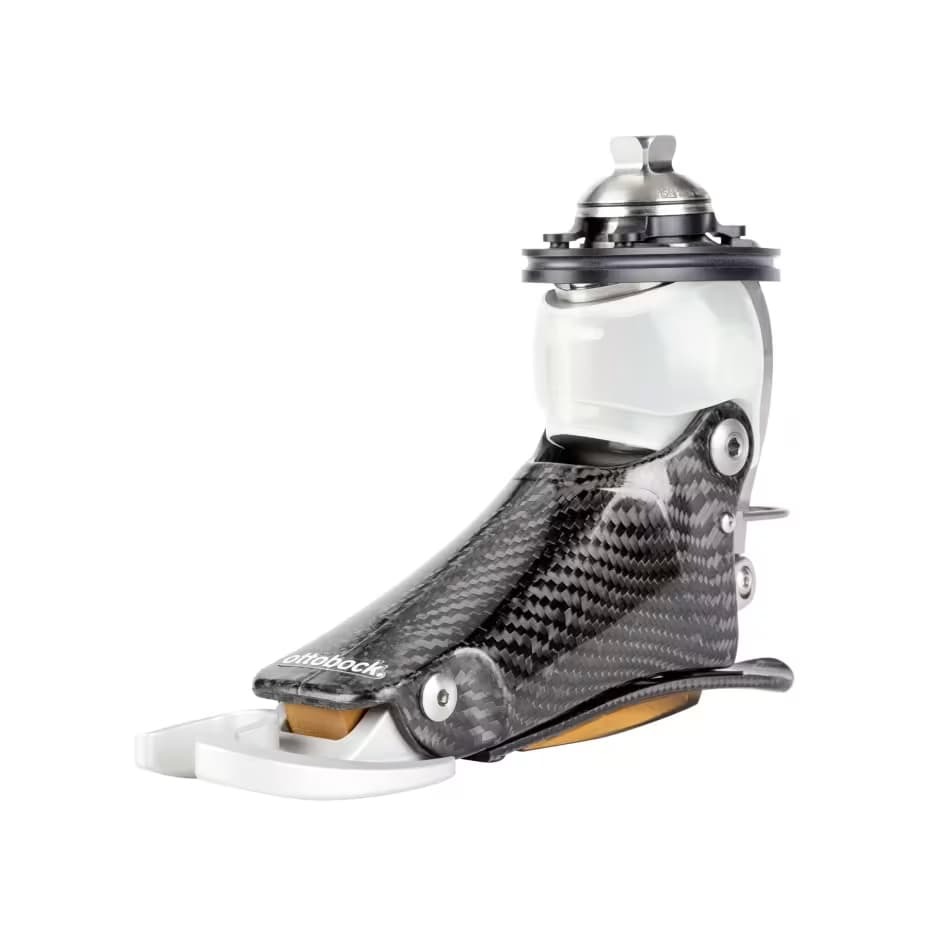
Dynamic-Response or Energy-Storing Feet
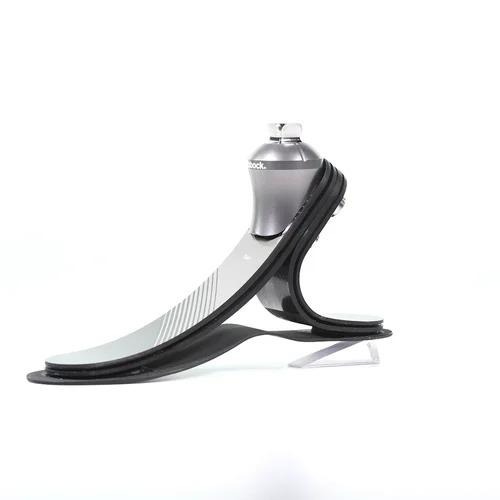
Example of a carbon-fibre dynamic-response prosthetic foot.
Image source: Limbs 4 Life / product imagery
Dynamic-response feet are commonly used by people with moderate to high activity levels. You may also hear them called energy-storing-and-return feet.
These designs often use carbon fibre or other spring-like materials. As weight moves onto the prosthetic foot, the material bends and stores some mechanical energy. As the person moves forward, some of that energy is released.
This does not mean the foot creates energy. Rather, it stores and returns part of the energy placed into it during walking.
Potential advantages include:
● Smoother progression during walking
● Greater energy return than basic prosthetic feet
● Can support faster walking speeds
● Often suitable for more active community walking
● Some designs perform well during recreational activities
Potential limitations include:
● Usually more expensive
● May require sufficient strength and control to take advantage of the design
● Not every user benefits from the same stiffness or configuration
● Funding may limit access to some models
The stiffness of a dynamic-response foot is important. A foot that is too stiff or too flexible for the user can affect comfort and performance.
Split-Toe and Split-Keel Designs

Example of a split-toe carbon prosthetic foot design.
Image source: Embreis
Some dynamic-response feet use a split-toe or split-keel design. The front portion of the foot is divided so that the two sides can respond somewhat independently.
This may help the foot adapt to uneven ground and provide additional side-to-side compliance.
For people who regularly walk outdoors or across irregular surfaces, this feature may improve comfort or confidence. However, performance depends on the entire foot design rather than the split keel alone.
Hydraulic-Ankle Feet
Hydraulic ankle systems use fluid-controlled mechanisms to allow the ankle to move and adapt during walking.
Depending on the design, the ankle may adjust when walking up or down slopes, standing on inclined surfaces, or moving through different phases of the walking cycle.
Potential advantages can include:
● Improved adaptation to slopes
● Smoother movement through the walking cycle
● Potentially improved comfort when standing or walking on inclines
● May reduce some compensatory movements
Potential limitations can include:
● Additional weight
● Higher cost
● More mechanical complexity
● Potential maintenance requirements
● Not appropriate or necessary for every user
Some people notice a substantial difference with hydraulic ankle movement, while others may prefer a lighter or more responsive non-hydraulic design.
Microprocessor-Controlled Feet and Ankles
Microprocessor-controlled prosthetic feet and ankles use sensors, electronics, and software to adjust aspects of ankle position or resistance.
Depending on the system, the prosthesis may recognize changes in terrain, walking speed, slopes, stairs, or standing position and adjust automatically.
Some systems can move the ankle into a different position for sitting or standing. Others are designed to improve adaptation when walking uphill or downhill.
Potential advantages include:
● Automatic adaptation to certain terrain changes
● Improved positioning on slopes with some systems
● Potential benefits for balance and stability
● May make some everyday movements easier
● Some models provide adjustable settings
Potential limitations include:
● Higher cost
● Additional weight
● Requires charging on many systems
● Electronic components require appropriate care
● May have restrictions around water exposure depending on the model
● Funding may be limited
A microprocessor-controlled foot is not automatically better for every person. The additional technology needs to provide a meaningful functional benefit for your lifestyle.
Powered Prosthetic Ankles and Feet
Powered prosthetic ankles go beyond passive energy storage by using motors, batteries, or other powered systems to actively assist movement.
Some are designed to provide active push-off or ankle motion during walking.
This technology can potentially reduce some of the physical effort associated with walking and reproduce certain aspects of biological ankle movement more closely.
However, powered systems can be heavier, more expensive, and more complex. Battery life, charging, maintenance, noise, environmental restrictions, and funding can all be considerations.
Powered prosthetic technology continues to evolve, but suitability should be evaluated according to individual needs rather than technology alone.
Prosthetic Feet for Sports and Recreation
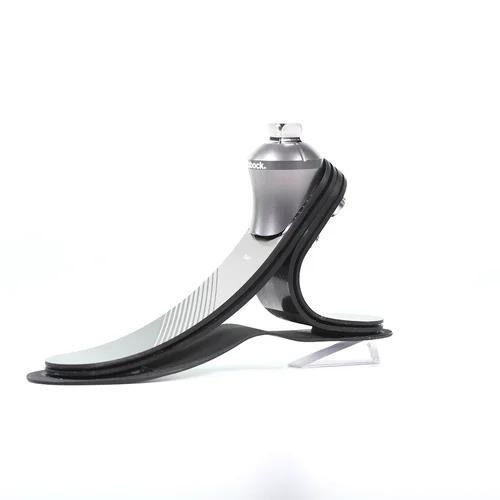
Dynamic-response carbon construction is also the basis of many sport-specific prosthetic feet.
Image source: Limbs 4 Life / product imagery
Everyday prosthetic feet are not necessarily ideal for every recreational activity.
Specialized prosthetic feet and components are available for activities such as:
● Running
● Hiking
● Swimming
● Cycling
● Golf
● Skiing
● Snowboarding
● Court sports
● Water activities
Running blades are probably the most recognizable example. They are designed for running rather than ordinary everyday walking and function very differently from a conventional prosthetic foot.
Some people use one prosthesis for daily activities and another for sports or water activities. Funding for recreational prostheses varies, and specialized equipment can be expensive.
Waterproof and Water-Resistant Feet
If swimming, boating, showering, fishing, beach activities, or other wet environments are important to you, discuss this before selecting components.
Some prosthetic feet and components are designed for water exposure, while others are only water-resistant or should not be submerged.
It is important to understand the manufacturer’s specific limitations. A waterproof foot does not necessarily mean that every component of the entire prosthesis is waterproof.
Ask your prosthetist exactly what type of water exposure is permitted and what cleaning or drying procedures are required afterward.
Heel Height and Footwear
Footwear can significantly affect prosthetic alignment.
Many prosthetic feet are designed around a particular heel height. Changing from a flat shoe to a shoe with a substantially different heel height can alter the alignment of the entire prosthesis and affect knee stability, posture, comfort, and walking.
Some prosthetic feet have adjustable heel-height features that allow users to wear a wider variety of shoes.
If footwear is important to you, discuss it before the prosthesis is built. Bring examples of the shoes you regularly wear to your prosthetic appointments when requested.
Weight Matters
Advanced technology often adds features, but features can add weight.
For some users, the functional benefits are worth the additional weight. For others, a lighter and simpler prosthetic foot may feel better and be easier to use throughout the day.
The weight of a prosthetic foot should therefore be considered alongside its performance.
Your Health Can Affect the Best Choice
Component selection should consider your overall health as well as your activity goals.
Factors that may influence the decision include:
● Balance
● Muscle strength
● Joint problems
● Vision
● Sensation
● Residual-limb condition
● Skin health
● Cardiovascular endurance
● Other medical conditions
● Risk of falls
A highly responsive foot may be excellent for one person and inappropriate for another.
The objective is not to qualify for the most advanced technology. It is to find a component that helps you function safely and effectively.
Above-Knee Users Have Additional Considerations
For someone with an above-knee amputation, the prosthetic foot cannot be considered entirely separately from the prosthetic knee.
The knee and foot need to work together. The behaviour of one component can affect the performance and stability of the other.
Your prosthetist should consider the complete prosthetic system rather than selecting each component in isolation.
Bilateral Limb Loss Creates Different Considerations
People with bilateral lower-limb loss may have different priorities than someone using one prosthetic leg.
Balance, stability, energy use, component weight, terrain adaptation, and symmetry may become particularly important.
The best combination of components may also differ between the two sides depending on amputation levels and residual-limb characteristics.
For bilateral users, trialling different component combinations when possible can be especially useful.
Can You Trial a Prosthetic Foot?
In some circumstances, manufacturers or prosthetic clinics may allow a component to be trialled before a final decision is made.
If this is available, it can provide valuable information.
When testing a foot, consider more than how it feels during the first few steps. Think about:
● Stability
● Comfort
● Walking speed
● Turning
● Ramps
● Slopes
● Uneven ground
● Stairs
● Standing
● Sitting down and getting up
● Fatigue after extended use
● Confidence
Ask your prosthetist how long a trial is available and whether alignment can be properly adjusted for each component being compared.
The Most Expensive Foot Is Not Necessarily the Best
It is easy to associate price with quality, particularly when comparing sophisticated prosthetic technologies.
But the best prosthetic foot is the one that provides the right combination of stability, comfort, function, reliability, and performance for you.
Someone may function extremely well with a relatively simple dynamic-response foot while finding a much more expensive electronic ankle unnecessarily heavy or complicated.
Another person may experience a major improvement in daily mobility from that electronic technology.
The value of a component depends on what it does for the person using it.
Questions to Ask Your Prosthetist
About the Foot
● Why are you recommending this particular foot?
● What type of foot is it?
● What are its main advantages?
● What are its limitations?
● What alternatives should I consider?
● How does it compare with my current foot, if I already use one?
About Your Activities
● Will it work well on grass and uneven terrain?
● How does it perform on ramps and slopes?
● Can I use it for recreational activities?
● Can it be exposed to water?
● Are there activities I should avoid?
About Footwear
● What heel height is the foot aligned for?
● Can I change shoes?
● How much heel-height variation is acceptable?
● Is an adjustable heel-height option available?
About Maintenance
● What maintenance does the foot require?
● How long is it expected to last?
● What signs indicate that it needs servicing?
● What is the warranty?
● What happens if it breaks?
About Funding
● What is the total cost?
● How much is covered by my funding program or insurance?
● What will I have to pay personally?
● Are there comparable alternatives that are covered?
● Can I trial this component before making a final decision?
Do Not Be Afraid to Ask Why
You may hear unfamiliar terminology during prosthetic appointments. Carbon keel. Hydraulic ankle. Multi-axial movement. Energy return. Microprocessor control. K-level.
You are not expected to understand all of this automatically.
Ask your prosthetist to explain the technology in everyday language and, most importantly, explain what it means for you.
Instead of only asking what a component does, ask how that feature could affect your everyday life.
A good prosthetist should be able to explain the reasoning behind a recommendation.
Your Needs May Change Over Time
The prosthetic foot that is appropriate when you receive your first prosthesis may not be the foot you use several years later.
Your strength may improve. Your walking ability may change. You may become more active. Your work may change. You may develop new interests or medical conditions. New technology may become available.
Prosthetic component selection should be revisited as your circumstances change.
Finding the Right Foot Is About Finding the Right Fit for Your Life
There is no universally best prosthetic foot.
For one person, the ideal foot may be simple, lightweight, stable, and dependable. For another, it may be a carbon-fibre dynamic-response foot that supports an active lifestyle. Someone else may benefit significantly from hydraulic or microprocessor-controlled ankle movement.
The important question is not, “What is the best prosthetic foot?”
The better question is, “What is the best prosthetic foot for me?”
That answer should take into account your mobility, health, environment, goals, comfort, safety, funding, and the activities that give your life meaning.
Learning From Other People Living With Limb Loss
Your prosthetist is the appropriate professional to assess and prescribe prosthetic components, but conversations with experienced prosthesis users can help you understand what questions to ask.
People living with limb loss can share what different feet feel like in everyday situations—walking through a grocery store, crossing a lawn, travelling, standing for long periods, dealing with snow or rain, or spending an entire day in a prosthesis.
Limbloss Connection provides opportunities for people living with limb loss and limb difference to share experiences, learn from one another, and discuss the practical realities of prosthetic use.
Peer experience should complement—not replace—the advice of your prosthetist and rehabilitation team. The goal is to give you more information so that you can participate confidently in decisions about your prosthetic care.