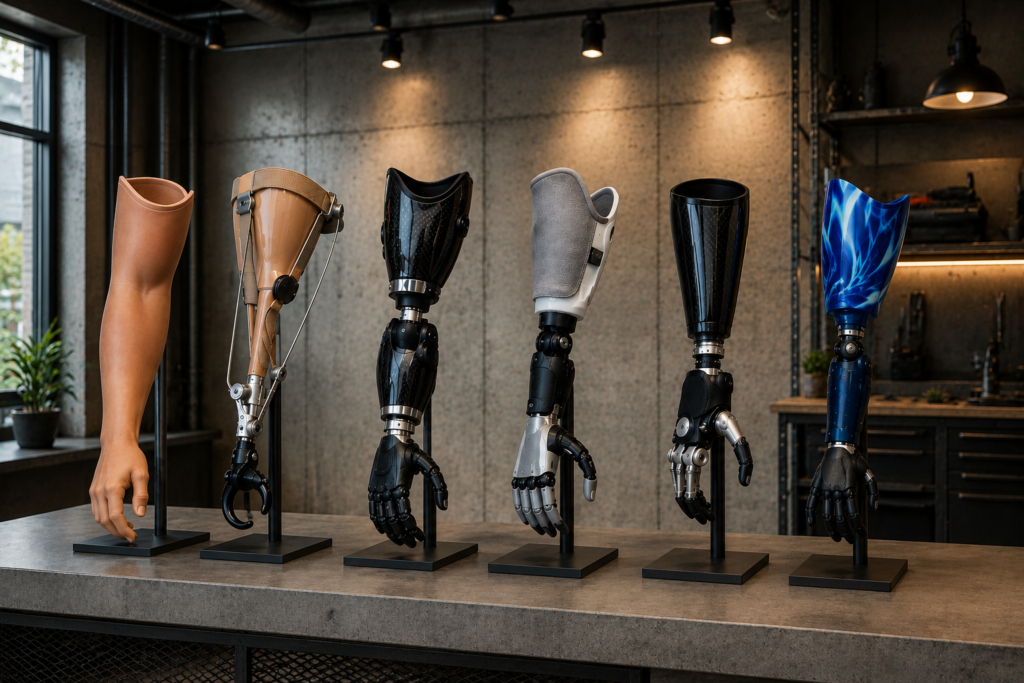
Upper-limb prosthetics can look very different from one person to another. Some devices are designed primarily to restore appearance or provide a stable surface for everyday tasks. Others use cables, motors, sensors, or specialized attachments to help a person grasp, carry, work, exercise, cook, drive, or participate in hobbies.
There is no single prosthetic arm or hand that is best for everyone. The right option depends on the level of limb loss or limb difference, the condition of the residual limb, strength and range of motion, the activities a person wants to perform, comfort, weight, maintenance, funding, and personal preference.
It is also important to know that using no prosthesis is a valid option for some people. Others may use more than one prosthesis or terminal device because different tools work better for different parts of life.
Understanding the Main Parts of an Upper-Limb Prosthesis
Upper-limb prostheses vary widely, but many systems contain several common elements. Understanding these parts makes it easier to compare options and ask useful questions during prosthetic appointments.
● Socket or interface — connects the prosthesis to the residual limb.
● Suspension system — helps keep the prosthesis securely attached.
● Control system — may be body-powered, myoelectric, electronic, manual, or a combination.
● Wrist unit — positions or rotates the terminal device.
● Terminal device — the hand, hook, prehensor, or specialized attachment used to interact with objects.
● Elbow unit — included when the level of limb loss requires an artificial elbow.
● Battery and electronics — used in electrically powered systems.
The exact combination depends heavily on the level of limb loss. A partial-hand prosthesis is very different from a prosthesis used after an above-elbow or shoulder-level amputation.
Option 1: No Prosthesis
Not everyone with upper-limb loss or limb difference chooses to wear a prosthesis. Some people find that their residual limb, sound hand, adaptive techniques, and everyday assistive devices allow them to function effectively without one.
This can be especially relevant for some people with finger or partial-hand differences, although the decision is highly individual.
Choosing not to use a prosthesis does not mean rehabilitation has failed. The goal is function, independence, comfort, and participation in life—not simply wearing a device.
An occupational therapist or upper-limb prosthetist can help assess whether compensating with the other arm is creating problems with posture, joint strain, or overuse.
Option 2: Functional Aesthetic and Passive Prostheses
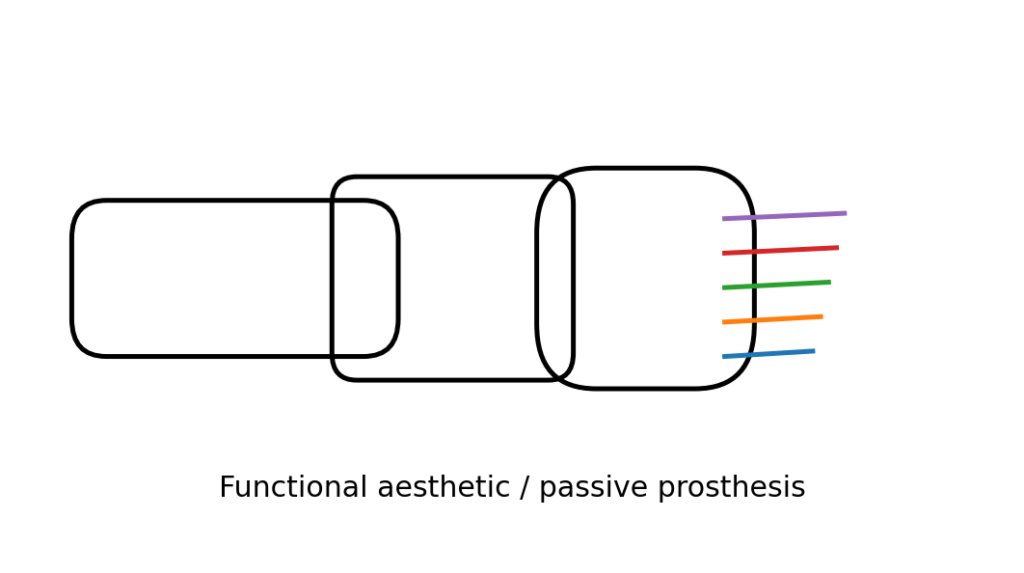
Illustration: functional aesthetic or passive upper-limb prosthesis.
Passive prostheses do not use powered movement in the same way as body-powered or myoelectric devices. Some are designed to closely resemble a biological hand or arm, while others deliberately have a mechanical or contemporary appearance.
Although they are sometimes described as cosmetic devices, that description can underestimate their usefulness. A passive prosthesis can provide a surface for stabilizing, supporting, pushing, carrying, or holding objects against the body.
Some passive hands or fingers can also be manually positioned into a particular posture.
Potential advantages include:
● Natural or customized appearance can be possible.
● Often quieter than powered systems.
● May require less maintenance than complex electronic devices.
● Can assist with stabilizing and supporting objects.
● May be useful for social, professional, or everyday activities.
Potential limitations include:
● Limited active movement.
● Some tasks require the sound hand to position the device.
● Highly realistic silicone restorations can require specialized care.
● Function may be more limited than with actively controlled systems.
Option 3: Body-Powered Prostheses
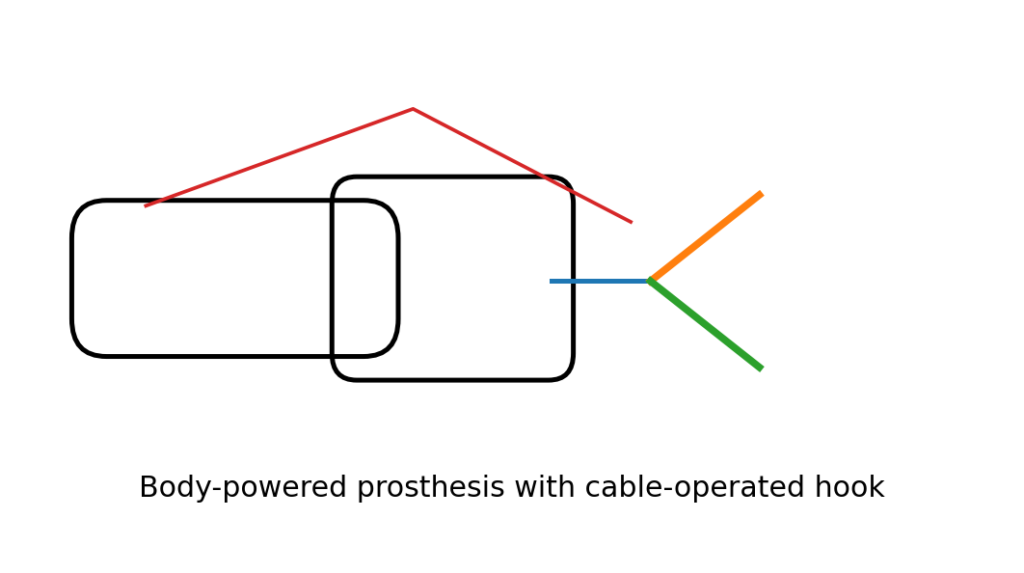
Illustration: body-powered prosthesis with a cable-operated hook.
Body-powered prostheses use movement of the body to operate the device. For many above-wrist systems, a harness and cable capture movement from the shoulder, upper arm, chest, or back. That movement is transferred mechanically to a hook, hand, elbow, or other component.
The principle is somewhat similar to pulling a bicycle brake cable.
Body-powered devices have been used for decades because they can be durable, dependable, relatively lightweight, and effective for many everyday and work-related tasks.
Body-Powered Hooks
Hooks are among the best-known upper-limb terminal devices. Their narrow tips can provide a clear view of the object being grasped and can be useful for precise work.
Different designs may be voluntary-opening or voluntary-closing. The way grip force is generated differs between these systems.
Potential advantages of body-powered systems include:
● Durability and mechanical simplicity.
● No battery charging for basic mechanical systems.
● Useful feedback through cable tension.
● Often well suited to demanding work environments.
● Hooks can provide precise and repeatable grasping.
● May tolerate conditions that are difficult for some electronic devices.
Potential limitations include:
● Harnesses may be uncomfortable for some users.
● Operating the device requires body movement and physical effort.
● Repeated shoulder or upper-body movements can contribute to fatigue or overuse.
● Some users prefer the appearance or movement of an electric hand.
Option 4: Myoelectric and Electrically Powered Prostheses
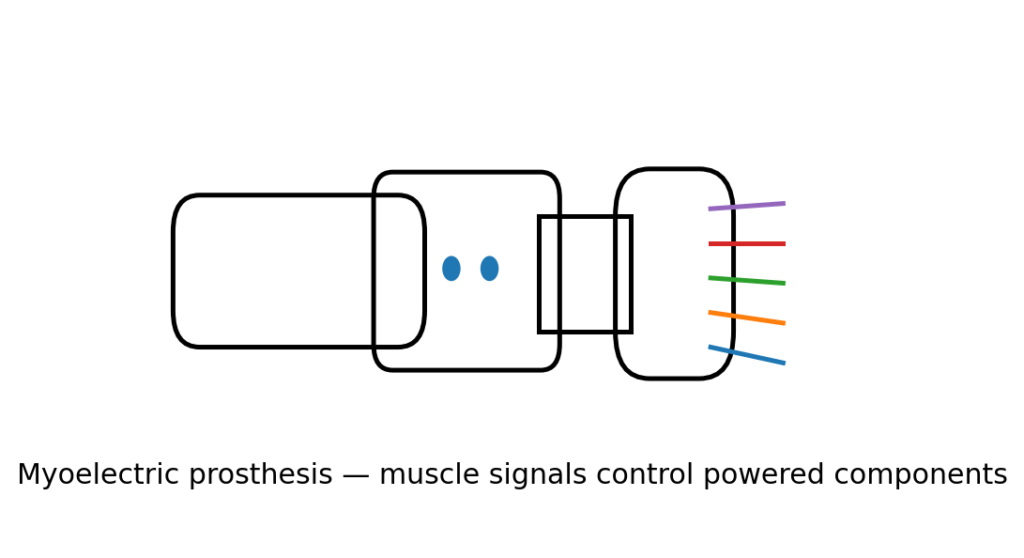
Illustration: myoelectric prosthesis using muscle signals to control powered components.
Myoelectric prostheses use electrical activity generated by muscles to control powered components. Sensors or electrodes positioned against the skin detect muscle signals. Those signals are interpreted by the prosthetic system and used to operate a hand, hook, wrist, elbow, or other component.
For example, a user may contract one muscle group to open a hand and another to close it. More advanced control systems may allow additional functions or different methods of switching between grips.
Potential advantages include:
● Powered grasping can reduce the physical effort needed to operate a terminal device.
● A harness may not be required for some configurations.
● Electric hands and hooks can provide substantial grip force.
● Multi-articulating hands can offer several programmed grip patterns.
● Electronic wrists and elbows can expand positioning options.
Potential limitations include:
● Usually heavier than simple passive or body-powered devices.
● Batteries require charging.
● Electronic systems are generally more expensive.
● Repairs can be more complex.
● Some systems have environmental or water-exposure restrictions.
● Learning to control the prosthesis can require significant training.
Multi-Articulating Myoelectric Hands
Traditional electric hands often open and close in a relatively simple pattern. Multi-articulating hands use individually powered or mechanically linked fingers to provide several grasp patterns.
Depending on the hand, these may include a power grip for larger objects, a precision pinch for smaller objects, a key grip, or other programmed positions.
The additional options can be useful, but more grip patterns do not automatically make a hand better. The user still needs to be able to select and control those functions reliably in everyday situations.
Weight, durability, speed, grip force, hand size, glove maintenance, water resistance, and funding should all be considered.
Electric Hooks and Terminal Devices
An electric hook or prehensor combines powered operation with a functional shape designed for grasping. Some users prefer electric hooks because the tips remain visible while manipulating an object, and certain models provide strong or precise grip.
A prosthetic hand and a prosthetic hook should not be viewed simply as an appearance-versus-function choice. Both can be highly functional, and some users have interchangeable terminal devices for different situations.
Option 5: Hybrid Prosthetic Systems
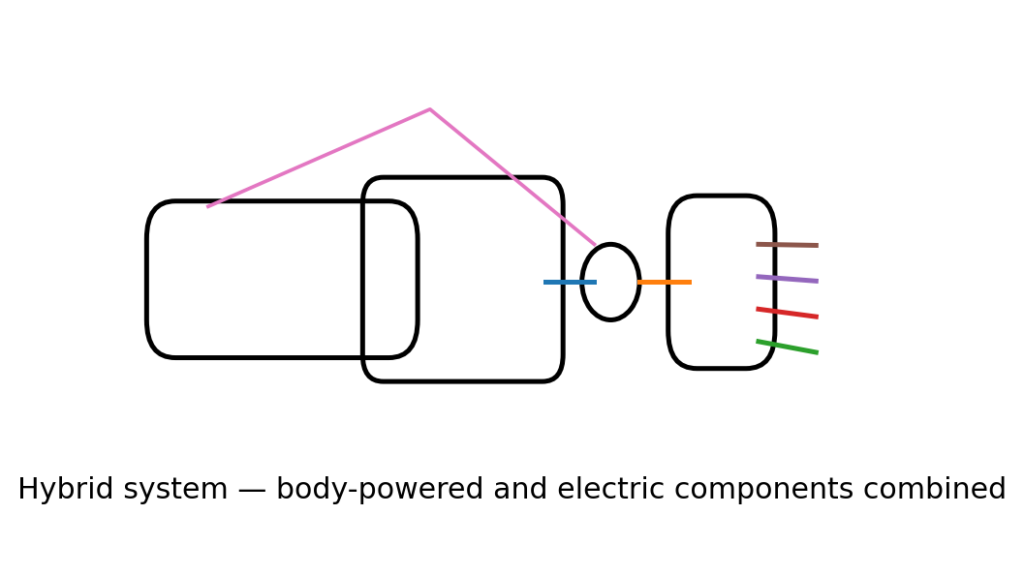
Illustration: hybrid upper-limb prosthesis combining mechanical and powered components.
A hybrid prosthesis combines two different control approaches, commonly body-powered and electrically powered components.
Hybrid systems are particularly relevant for some people with above-elbow limb loss because several joints or components may need to be controlled.
For example, a person might use body movement to position or operate an elbow while using myoelectric signals to control the terminal device.
Potential advantages include:
● Can combine the strengths of mechanical and powered technologies.
● May simplify control of a prosthesis with several moving components.
● Can provide a practical balance between weight, function, and power.
● Can be customized around the user’s priorities.
Potential limitations include:
● More complex than a simple single-control system.
● Requires training and practice.
● Component combinations can add weight.
● Cost and maintenance depend on the components selected.
Option 6: Activity-Specific Prostheses
Illustration: an activity-specific terminal device designed around a particular task.
Sometimes the best prosthetic hand is not a hand at all.
Activity-specific prostheses are designed around a particular task, sport, hobby, or occupation. Instead of trying to imitate the shape and function of a biological hand, the terminal device is designed to connect effectively with the equipment being used.
Activity-specific devices may be developed for:
● Cycling
● Weight training
● Golf
● Fishing
● Archery
● Swimming and water activities
● Hockey or other sports
● Musical instruments
● Cooking
● Tools and trades
● Workplace equipment
A specialized device may perform one activity exceptionally well while being impractical for general daily use. For that reason, some people use an everyday prosthesis plus one or more specialized devices.
Partial-Hand and Finger Prostheses
People with finger or partial-hand limb loss have a wide range of options because the amount of remaining hand function can vary dramatically.
Options can include silicone finger restorations, passive positionable fingers, mechanically driven finger prostheses, body-powered devices that move with the remaining fingers, and electrically powered partial-hand systems.
Preserving and using remaining sensation is especially important. A prosthesis should complement useful residual-hand function rather than unnecessarily covering or restricting it.
Below-Elbow Prostheses
A below-elbow, or transradial, prosthesis typically preserves the person’s biological elbow. This can provide important advantages because elbow movement remains natural.
Depending on the person’s needs, options may include passive, body-powered, myoelectric, electric, or activity-specific systems.
Socket comfort, suspension, wrist positioning, terminal-device choice, and overall weight can strongly influence whether the prosthesis is comfortable enough to use throughout the day.
Above-Elbow Prostheses
An above-elbow, or transhumeral, prosthesis must replace both the missing forearm/hand and the function of the elbow.
This increases complexity because the user needs to position the elbow as well as control the terminal device. Mechanical elbows, powered elbows, body-powered systems, myoelectric systems, and hybrid combinations may all be considered.
Weight becomes particularly important because every component is being supported higher on the arm.
Shoulder-Level Limb Loss
Prosthetic fitting after shoulder disarticulation or very high-level upper-limb loss is particularly complex. The prosthesis may need to replace shoulder positioning, elbow function, wrist positioning, and the terminal device.
The benefits of a prosthesis need to be balanced against weight, control complexity, comfort, and the amount of energy required to use it.
For some people, a prosthesis may be valuable for specific tasks rather than something worn continuously.
Socket Fit and Comfort Matter
Advanced technology cannot compensate for a socket that is painful or unstable.
The socket must support and suspend the prosthesis while distributing pressure appropriately. It may also need to maintain reliable contact with myoelectric electrodes.
Tell your prosthetist about:
● Pain or pressure points
● Skin irritation
● Changes in residual-limb volume
● Sweating
● Movement or slipping inside the socket
● Difficulty controlling the device
● Changes in comfort throughout the day
A prosthesis that remains in a closet because it is uncomfortable provides no functional benefit.
Weight Is an Important Consideration
Upper-limb prostheses can become tiring because their weight is carried by the residual limb, shoulder, and surrounding muscles.
More technology can mean more motors, batteries, joints, and structural components. The most sophisticated system is therefore not automatically the most comfortable or practical.
Ask to compare the weight of different options and, when possible, evaluate how a device feels after more than a few minutes.
Training Is Part of the Prosthesis
Receiving an upper-limb prosthesis is only the beginning. Occupational therapy can be critical for learning how to use the device efficiently.
Training may include:
● Putting on and removing the prosthesis
● Controlling opening and closing
● Selecting grip patterns
● Positioning the wrist and elbow
● Using two hands together
● Eating and food preparation
● Dressing
● Work tasks
● Driving-related tasks when appropriate
● Sports and recreation
● Preventing compensatory movement and overuse
Good training can make the difference between owning a prosthesis and actually incorporating it into everyday life.
One Prosthesis May Not Do Everything
A biological hand is extraordinarily versatile. Expecting one prosthetic device to duplicate every function can be unrealistic.
Some experienced users have multiple terminal devices or prostheses. A myoelectric hand may work well for everyday activities, while a body-powered hook may be preferred for demanding work and a specialized attachment may be used for cycling or weight training.
The objective is not necessarily to find one device that does everything. It may be to develop the best combination of tools for your life.
Questions to Ask Your Prosthetist
About the Type of Prosthesis
● Why are you recommending this type of prosthesis for me?
● What other options are available?
● What are the advantages and disadvantages of each?
● Can I see or trial different terminal devices?
● How much does the complete prosthesis weigh?
About Function
● Which everyday tasks should this device make easier?
● What tasks will still be difficult?
● How much grip force does it provide?
● How quickly can I change between functions?
● Can I use interchangeable terminal devices?
About Durability and Maintenance
● Can it get wet?
● Can it tolerate dust, dirt, heat, or cold?
● How often does it need servicing?
● How long does the battery last?
● What happens if a component breaks?
● What warranty is included?
About Training
● How much occupational therapy is recommended?
● Will my therapist have experience with this type of device?
● Can the prosthesis be adjusted as my skills improve?
About Funding
● What is the complete cost?
● What portion is covered?
● What will I pay personally?
● Are replacement gloves, batteries, liners, or repairs covered?
● Are activity-specific devices funded?
● What future costs should I expect?
How to Decide What Is Right for You
The most advanced prosthesis is not automatically the best prosthesis.
A good choice should reflect what you actually want to do, how much weight you can comfortably tolerate, how much maintenance you are willing to manage, the environments where you will use the device, and how easily you can control it.
When possible, ask to handle or trial different options. Something that looks impressive in a demonstration may feel very different after several hours of real-world use.
Your preferences also matter. Appearance, sound, harnessing, battery charging, ease of repair, and the way the device feels socially can all affect whether you want to wear it.
Learning From Other People With Upper-Limb Loss
A prosthetist and occupational therapist provide the clinical and technical expertise needed to select and train with a prosthesis. Peer support adds another kind of knowledge: what it is actually like to use these devices every day.
Other people living with upper-limb loss can share practical experiences about battery life, harness comfort, durability, clothing, travel, work, repairs, grip selection, and when they choose not to wear a prosthesis.
Limbloss Connection provides opportunities for people living with limb loss and limb difference to connect, exchange experiences, and learn from one another.
Peer experience should complement professional advice rather than replace it. The goal is to help you understand your options and participate confidently in decisions about your prosthetic care.
The Best Prosthesis Is the One That Helps You Live Your Life
Upper-limb prosthetic technology ranges from beautifully realistic passive restorations to rugged mechanical hooks, multi-articulating myoelectric hands, powered elbows, and highly specialized devices designed for a single activity.
Each has strengths and limitations.
The right choice is not determined by which device looks the most advanced. It is determined by whether the prosthesis helps you accomplish the things that matter to you with an acceptable balance of comfort, effort, reliability, and independence.
Your needs may also change. A device that is right for you today may not be the one you choose several years from now.
Understanding the options gives you a stronger starting point for working with your prosthetist and rehabilitation team to build a solution around your life.