Mental Health and Amputation: Coping, Healing, and Support
“We’re going to have to take your limb.”
For many, these words echo like a seismic rupture. In a single moment, life divides itself into a clear before and after. The body you have lived in, depended on, and taken for granted will no longer exist in the same way. And while the physical reality of limb loss is immediate and visible, the emotional and psychological impact is often complex, insidious, and less acknowledged.
This blog is written for those standing on the edge of that moment—or those who have already been thrust into the aftermath. It explores the nuanced mental health challenges that accompany amputation, not as an abstract diagnosis, but as a deeply human experience filled with fear, grief, resilience, and ultimately, a chance for transformation.
The Psychological Earthquake of Amputation
Limb loss is not just a surgical event—it’s an existential upheaval. Whether it stems from trauma, disease, or a long medical journey, the moment you’re told amputation is necessary marks the beginning of a psychological reckoning. This is the moment uncertainty takes the wheel.
For many, the first reaction is not pain but disbelief—a stunned silence where everything feels suspended. Time slows. You may hear your doctor’s words, but your brain can’t fully absorb them. Questions begin to swirl:
- What does this mean for the life I’ve built?
- Who will I be now?
- Will I still be seen as capable, attractive, valuable?
- How much of my independence will be lost—or can be recovered?
In this moment, you are not only losing a limb—you are grappling with the loss of assumptions, routines, and perhaps even parts of your identity. The body has always been the stage on which we perform our lives. To lose part of it is to be forced to rewrite the script.
Grief in Its Many Forms
To understand the emotional toll of limb loss, we must talk openly about grief. Not just the tidy, five-stage model—but the messy, nonlinear reality of mourning a part of yourself.
Ambiguous Loss
Unlike death, limb loss is a kind of ambiguous loss. The limb is gone, but the sensations may persist through phantom pain. The world keeps moving forward, yet your inner world might feel paused, fractured, or out of sync. This kind of grief is hard to articulate and even harder to validate, especially when others expect you to “move on” quickly once the wound heals.
Loss of Function, Freedom, and Familiarity
Grief doesn’t just emerge from the physical change. It also stems from:
- The loss of spontaneous movement—climbing stairs, swimming, hugging with both arms.
- The loss of autonomy—needing help with bathing, dressing, or eating.
- The loss of social ease—wondering how people will stare, pity, or judge.
The mourning process can be re-triggered again and again—by an inaccessible building, a missed opportunity, or even an innocent question from a child. Each reminder stings like a new wound.
The Complexity of Coping with the Unknown
Humans are not just afraid of change—we’re afraid of not knowing. And limb loss plunges you into the unknown at every level: physical, psychological, relational, and financial.
While some aspects of healing are tangible (relearning to walk, adjusting prosthetics), the emotional healing process is amorphous. It often begins in darkness—through fear, fatigue, insomnia, disconnection, and even thoughts of giving up.
Yet coping isn’t about “being strong” in the traditional sense. It’s about allowing yourself to be real. To name the chaos. To sit in the discomfort without rushing to suppress it. True resilience is not the absence of emotion, but the ability to feel it fully and still move forward.
Psychological Anchors in Uncertainty
Here are a few grounding practices for navigating the psychological unknown:
- Radical Acceptance: This doesn’t mean liking or approving of your situation. It means acknowledging reality without resistance so you can begin to adapt meaningfully.
- Cognitive Reframing: Shift the lens. Instead of asking, “Why me?” try asking, “What now?” What can I still build, learn, or become?
- Trauma-Informed Therapy: Professionals trained in limb loss-related trauma can help process the emotional layers that come with medical trauma, bodily disruption, and identity fragmentation.
The Role of Community and Belonging
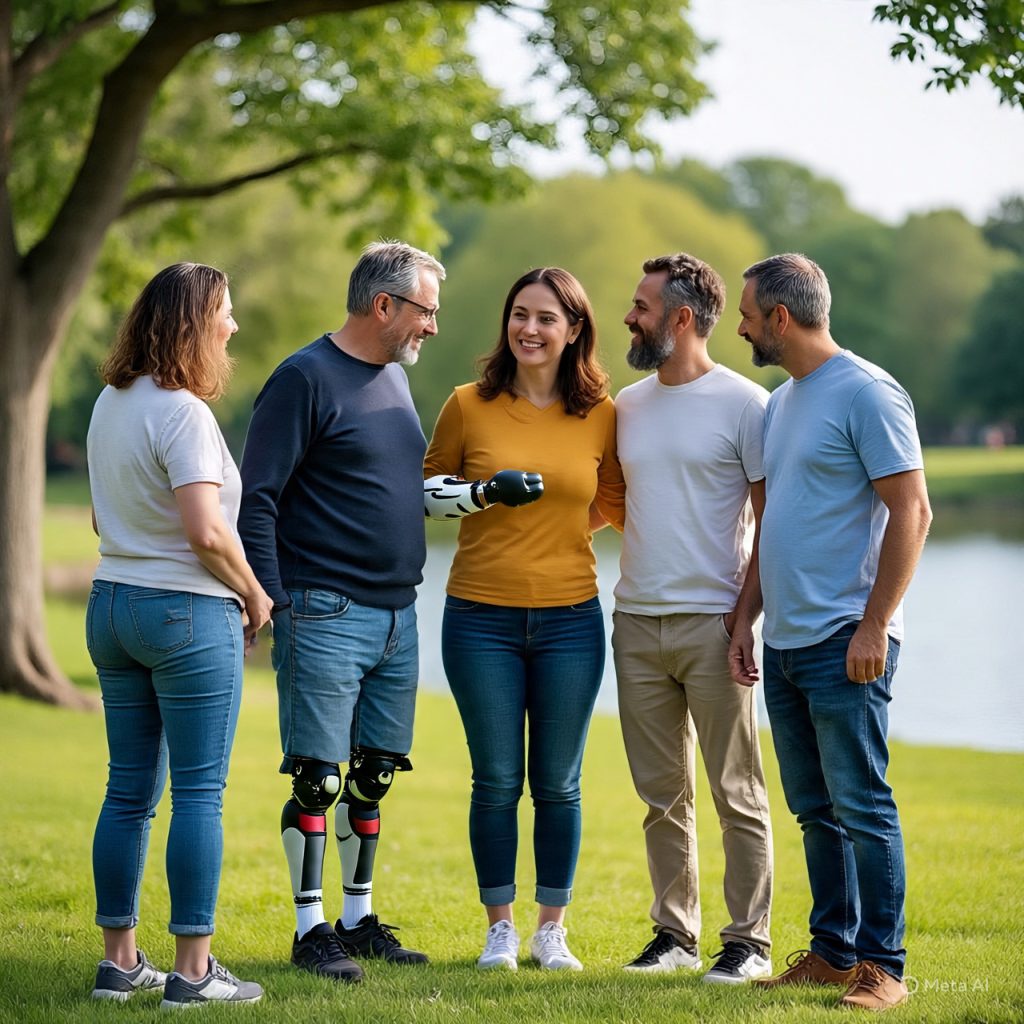
Amputation can feel deeply isolating. Even with loving people around you, it’s hard to feel understood unless someone has walked this particular road.
Connecting with others who have experienced limb loss can serve as a mirror—not only reflecting your pain, but also showing you what is still possible. These peers can share practical advice, yes—but they also model courage, normalcy, and life beyond amputation.
Why Peer Support Matters
- Validation: Sometimes the most healing words are simply, “I’ve been there too.”
- Identity Reconstruction: Witnessing others thriving helps reconstruct your own sense of potential.
- Reducing Shame: Limb loss often carries misplaced feelings of shame or failure. Community dissolves that shame with compassion and connection.
Redefining Self After Amputation
One of the most painful parts of limb loss is the fear that your former self is gone forever. But over time, many amputees come to a surprising and powerful realization: they are not less than—they are different, yes, but also deeper.
Reclaiming identity post-amputation isn’t about pretending everything is okay. It’s about evolving—shifting from “I am broken” to “I am becoming.” You are not the same, but you are not diminished. Many find that this path—however unwanted—opens new levels of emotional depth, spiritual growth, and empathy for others.
Your identity is not fixed to your limbs. It is shaped by your stories, your spirit, your relationships, your choices. And none of those have been amputated.
Healing is Not a Straight Line
There will be hard days. There will be setbacks. You may grieve the same thing ten times in ten different ways. That is not failure—it is healing. A living, breathing, non-linear process that changes shape with each new phase of your journey.
You are allowed to cry and laugh on the same day. You are allowed to feel weak and still be incredibly strong. You are allowed to mourn the loss and still find joy in what remains—or in what is yet to come.
You are not alone. There is a world of people—visible and invisible—walking beside you.And step by step, breath by breath, you will learn how to live again.